
0 views
Creating valuable content is only half the job. Even a well-researched blog post, helpful video, or informative social media update can struggle to reach the right audience if there is no clear plan for distributing it.
Many businesses publish content regularly but fail to get consistent results. They post on social media when they have time, share a blog link once, and then move on to the next topic. Over time, this approach becomes difficult to manage, wastes existing content opportunities, and makes marketing results unpredictable.
A sustainable content distribution strategy solves this problem by creating a repeatable process for getting content in front of the right people through the right channels. Instead of constantly producing new material, businesses learn how to reuse valuable ideas, prioritize effective platforms, and measure what actually contributes to growth.
In this guide, we will explain how to build a content distribution strategy that supports long-term visibility, audience engagement, website traffic, and lead generation without overwhelming your marketing team.
What Is a Sustainable Content Distribution Strategy?
A sustainable content distribution strategy is a long-term plan for sharing, repurposing, and promoting content across relevant marketing channels using manageable resources.
It connects content creation with the activities that help people discover and consume that content. These activities may include search engine optimization (SEO), social media marketing, email newsletters, online communities, partnerships, and paid advertising.
The goal is not to publish everywhere. It is to distribute useful content consistently on the channels where your audience is most likely to find it.
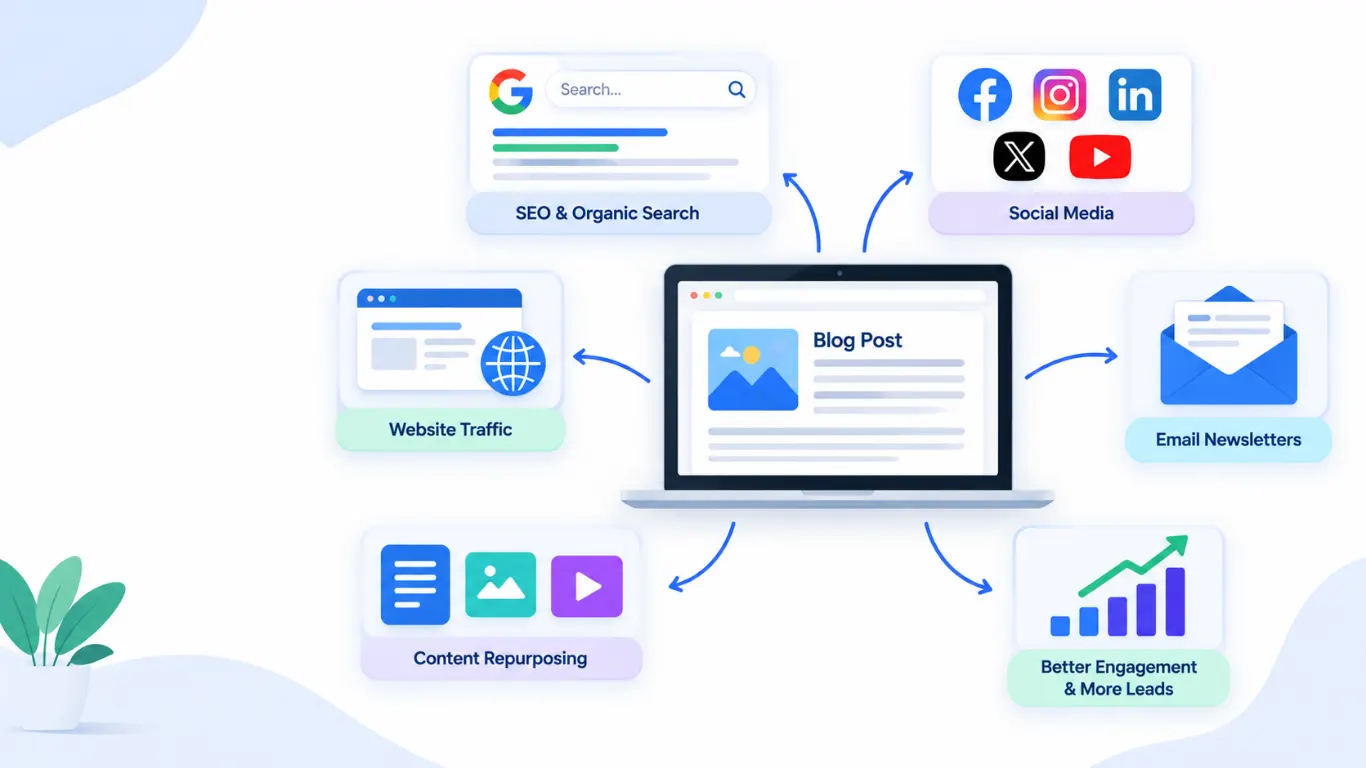
For example, a digital marketing company could publish a detailed blog about improving local search visibility. Rather than sharing the article once, the team could:
-
Optimize the article for relevant search queries.
-
Turn its main recommendations into a LinkedIn carousel.
-
Create short social media posts around individual tips.
-
Include the article in a relevant email newsletter.
-
Record a short video explaining one important takeaway.
-
Link to the article from related website content.
One useful piece of content can support several marketing activities without requiring the team to start from scratch each time.
The key principle is simple: sustainable distribution focuses on consistent reach, meaningful engagement, and measurable business outcomes rather than publishing volume alone.
Why Does Content Distribution Matter for Long-Term Growth?
Content distribution helps close the gap between creating content and getting results from it. A strong article cannot attract relevant visitors if your target audience never discovers it.
A well-planned distribution process offers several benefits.
1. It increases content visibility
Different people discover information in different ways. Some use Google, others follow brands on social media, and many rely on email newsletters or recommendations from trusted sources.
Distributing content through appropriate channels creates more opportunities for people to discover your business.
2. It improves the return on content investment
Researching, writing, designing, and reviewing content takes time. Reusing a strong article across multiple formats helps businesses get more value from that effort.
For example, one comprehensive guide could become several short posts, a checklist, an email topic, and a video script. Each format serves a different purpose while supporting the same central idea.
3. It creates consistent audience engagement
Audiences rarely become customers after seeing a single post. They may need several useful interactions before they understand your expertise or feel confident contacting your business.
A consistent distribution plan helps maintain those interactions over time.
4. It supports SEO and website traffic
Search engine optimization can help valuable content attract visitors over the long term. Social media, email, and other channels can provide additional discovery opportunities and bring readers back to relevant website pages.
For businesses investing in SEO services, content distribution should complement keyword research, content quality, internal linking, and technical website performance.
5. It makes marketing easier to manage
Without a defined process, every content launch can become a new task to figure out. A documented strategy clarifies which channels to use, who is responsible, when content should be shared, and how results will be evaluated.
This makes the process more manageable for small teams and growing businesses.
Step 1: Define Your Content Distribution Goals
Before choosing platforms, decide what you want your content to achieve. Different goals require different distribution methods, formats, and performance indicators.
For example, content intended to increase brand awareness will not necessarily be measured in the same way as content designed to generate sales enquiries.
Start by selecting one or two primary goals.
| Business goal | Suitable distribution channels | Metrics to monitor |
|---|---|---|
| Increase brand awareness | Social media, partnerships, video | Reach, relevant impressions, brand mentions |
| Grow organic traffic | Search-optimized blogs, resource pages | Organic clicks, relevant sessions |
| Generate leads | Email, service pages, webinars, targeted campaigns | Qualified leads, conversion rate |
| Build audience loyalty | Newsletters, communities, recurring content | Returning visitors, replies, engagement |
| Support sales | Case studies, comparison guides, email sequences | Sales conversations, influenced conversions |
Avoid choosing metrics simply because they are easy to track. A large number of impressions may look impressive, but it does not automatically mean your content is reaching potential customers.
If lead generation is the priority, focus on qualified enquiries, conversion rates, and the quality of those leads.
A clear goal makes it easier to decide whether your content distribution efforts are working.
Step 2: Understand Your Target Audience
A sustainable strategy begins with understanding the people you want to reach.
Think about your audience’s needs, questions, challenges, and preferred ways of consuming information. A small business owner looking for practical marketing advice may prefer concise guides, checklists, and short videos. A marketing manager evaluating a service provider may want detailed comparisons, case studies, and evidence of expertise.
Use the information available from:
-
Customer questions and sales conversations.
-
Website analytics and search performance reports.
-
Social media comments and messages.
-
Email replies and newsletter engagement.
-
Customer feedback, surveys, and support enquiries.
-
Search queries that bring people to your website.
Look for recurring questions that your content can answer.
For instance, if potential customers regularly ask how much SEO costs, you could create a detailed pricing guide and distribute it through search, email, and social media.
The important thing is to connect content with real audience needs rather than choosing topics solely because they are popular.
Match content to the customer journey
People need different information depending on how familiar they are with your business.
-
Awareness stage: Educational blogs, short videos, social posts, and beginner-friendly guides.
-
Consideration stage: Detailed comparisons, practical tutorials, webinars, and case studies.
-
Decision stage: Service explanations, testimonials, pricing information, demonstrations, and consultation pages.
-
Retention stage: Helpful newsletters, product updates, advanced guides, and customer resources.
Distributing the right content at the right stage creates a more useful customer experience and gives each piece a clear purpose.
Step 3: Choose the Right Content Distribution Channels
One of the biggest mistakes businesses make is trying to maintain a presence on every platform. This often leads to inconsistent posting, rushed content, and unnecessary pressure on small marketing teams.
A sustainable content distribution strategy prioritizes the channels that support your goals and match your audience’s habits.
1. Search engines and organic content
Search engines can help people discover useful content when they are actively looking for answers. Blog posts, guides, comparison pages, and educational resources can attract relevant visitors over time.
To make content easier to discover:
-
Research the search intent behind your target keywords.
-
Use descriptive titles and clear headings.
-
Answer the main question early in the article.
-
Add relevant internal links to related content and service pages.
-
Keep important information accurate and updated.
-
Make sure your website is accessible, mobile-friendly, and easy to navigate.
SEO is a long-term distribution channel, so results may take time. However, useful content can continue attracting relevant visitors long after its publication date.
2. Social media platforms
Social media can introduce your content to people who may not discover it through search. However, each platform has different audience expectations.
For example, LinkedIn may suit professional insights, business case studies, and B2B educational content. Instagram may work better for visual explanations, short videos, and creative demonstrations. YouTube can support tutorials, product demonstrations, and detailed educational videos.
Rather than copying the same post everywhere, adapt the presentation to each platform.
A detailed blog post might become a professional LinkedIn post, an Instagram carousel, or a short YouTube video. The central message stays consistent, but the format fits the channel.
Businesses that need help maintaining a consistent social presence can explore social media marketing services as part of a broader distribution plan. Use the correct live service-page URL when adding this internal link to your website.
3. Email newsletters
Email gives you a direct way to share useful content with people who have chosen to hear from your business.
You can use newsletters to distribute new articles, share practical tips, highlight case studies, or recommend older resources that remain relevant.
A useful newsletter should offer value beyond simply announcing that a new blog has been published. Summarize the key takeaway, explain why it matters, and give readers a clear reason to visit the full resource.
Keep your email schedule realistic. A useful newsletter sent consistently is generally more manageable than an ambitious schedule that your team cannot maintain.
4. Online communities and partnerships
Relevant industry communities, professional groups, podcasts, and partnerships can help your content reach new audiences.
The focus should be on contributing something useful. Answer questions, share expertise, and participate in discussions where your content genuinely adds value.
Avoid posting promotional links in unrelated communities or sending unsolicited messages to large numbers of people. These tactics can damage trust and may violate platform rules.
Choose only a few channels initially, learn how they perform, and expand when you have the resources to do so.
Step 4: Build a Content Repurposing System
Content repurposing is one of the most effective ways to make distribution sustainable. It allows you to present the same core information in different formats without creating an entirely new piece of content for every channel.
The process begins with a strong primary resource, sometimes called a pillar asset.
This could be a detailed blog post, original research report, webinar, expert interview, or comprehensive tutorial. Once it is ready, identify smaller ideas that can stand on their own.
Example: Repurpose one blog post into multiple formats
Imagine your business publishes a guide titled “How to Improve Website Conversion Rates.”
How to Research the Best Keywords | 97 Switch
1. Original blog post
Publish a detailed guide covering user experience, landing pages, forms, trust signals, and calls to action.
90 Canva Linkedin & Instagram Carousel Templates | Social Media Post Template for Coaches, Consultants | Content Creator (digital Download) – Etsy
2. Social media carousel
Turn five practical recommendations into a concise visual guide that readers can save and share.
Microlearning vs. Full-Length Lessons | VideoLearningAI
3. Short educational video
Explain one common conversion problem and demonstrate a practical way to address it.
Best SEO Newsletters Worth Reading in 2026 (Free & Paid)
4. Email newsletter
Share the most useful lesson from the guide and link readers to the complete article.
You could also turn the article into a checklist, a sales-team resource, or a section of a future webinar.
The goal is not to distribute every asset in every possible format. Select the versions that make sense for your audience and available resources.
Keep repurposed content useful
Repurposing should not mean copying the same paragraph across multiple platforms. Each version should make sense on its own.
A video needs a strong opening and a clear explanation. An email should provide context. A carousel should communicate its ideas visually. A blog post should answer the reader’s question in sufficient depth.
This approach keeps your content consistent without making your distribution feel repetitive.
Step 5: Create a Realistic Distribution Calendar
A content calendar helps transform a strategy into a repeatable workflow. It shows what will be published, where it will be shared, and who is responsible for each task.
Start with a schedule your team can maintain for several months rather than one that looks impressive for a single week.
For example, a small business might publish two blog posts per month, create several social updates from each post, and send one or two newsletters. The right frequency depends on your audience, budget, team capacity, and business goals.
Here is a sample weekly distribution schedule for one primary article.
| Day | Distribution activity | Purpose |
|---|---|---|
| Monday | Publish the blog and optimize its on-page SEO | Build a searchable resource |
| Tuesday | Share the main takeaway on LinkedIn | Reach a professional audience |
| Wednesday | Publish a short video or carousel | Explain one practical idea |
| Thursday | Send a relevant email to subscribers | Drive targeted readership |
| Friday | Answer audience questions and review early signals | Encourage engagement and identify follow-up topics |
This is only an example. You do not need to distribute content every weekday to have a sustainable system.
Include a few practical details in your content calendar:
-
Content title and target audience.
-
Primary goal and intended call to action.
-
Publication date and distribution channels.
-
Required formats and creative assets.
-
Assigned owner and review deadline.
-
Links to published assets.
-
Performance review date.
A shared spreadsheet or project management tool is often enough to begin. The most useful calendar is the one your team actually updates.
Step 6: Connect Content Distribution With SEO and Internal Linking
Content distribution should not stop when someone clicks a link. The destination should help the visitor find relevant information and take the next logical step.
This is where SEO and internal linking become valuable parts of your strategy.
Build connections between related content
Suppose your website publishes articles about SEO, social media marketing, website performance, and lead generation.
Instead of treating each article as an isolated resource, link related pages together when the connection helps readers.
An article about content distribution could link naturally to:
-
A guide to search engine optimization — replace this general destination with your live SEO service or related guide URL.
-
A relevant article about social media marketing.
-
A guide to website conversion optimization.
-
A page explaining your lead generation services.
Internal links help visitors explore related information and make it easier for search engines to discover relationships between your pages.
Use descriptive anchor text that tells readers what they can expect. Avoid adding links simply to insert keywords or directing every article to the same page.
Make the destination worth visiting
Before sharing a blog post widely, check that its landing page provides a good experience.
The page should load properly, work on mobile devices, use readable formatting, and offer a clear next step where appropriate. If the content is designed to generate enquiries, a relevant contact form or service link may help.
For companies investing in website design and development, content distribution and website experience should work together. Sending more visitors to a confusing or slow page may not produce the results you want.
Step 7: Use Paid Promotion Selectively
Organic distribution is useful for building long-term visibility, but some content may benefit from paid promotion.
Paid advertising can help a business test audience interest, promote a time-sensitive resource, or reach a relevant group beyond its existing followers.
However, paying to promote every blog post is rarely a sensible starting point for a business with limited resources.
Instead, look for content that has a clear purpose and a strong reason to reach a larger audience.
Examples include:
-
A detailed industry report that supports brand authority.
-
A useful guide connected to a lead generation campaign.
-
A webinar addressing a specific customer problem.
-
A case study that supports a relevant sales conversation.
Before investing, decide what success looks like. Depending on the campaign, this might be qualified website visits, registrations, enquiries, or sales.
If paid promotion is part of your plan, relevant Google Ads management may help you reach people actively searching for a solution, while social advertising can support discovery and audience engagement. Select the channel based on the content, audience, and campaign objective.
Paid promotion should complement useful organic distribution, not replace content quality or audience understanding.
Step 8: Measure the Results That Matter
A sustainable strategy needs a regular feedback loop. Without measurement, it is difficult to know which channels deserve more attention and which activities consume time without contributing meaningful results.
Start with a small group of metrics connected to your goals.
Content distribution metrics to track
Reach and visibility
-
Impressions and reach on social platforms.
-
Organic clicks from search.
-
Referral traffic from relevant websites.
-
Email delivery and click-through rates.
Engagement and content quality
-
Meaningful comments, shares, and saves.
-
Time spent engaging with content, interpreted alongside other metrics.
-
Returning visitors.
-
Newsletter replies and audience feedback.
Business outcomes
-
Qualified enquiries and registrations.
-
Conversion rate from relevant landing pages.
-
Leads attributed to specific campaigns where tracking permits.
-
Cost per qualified lead for paid campaigns.
-
Sales influenced by content, where measurement is available.
Do not expect every channel to produce the same result. A social post might introduce your brand to new people, while an in-depth comparison article may support a buyer who is close to making a decision.
Use analytics tools, search performance reports, email platform data, and conversion tracking to understand these differences.
Review results and make practical adjustments
Review performance at a consistent interval, such as monthly. Look for patterns rather than reacting to every small fluctuation.
Ask questions such as:
-
Which topics attracted the most relevant audience?
-
Which distribution channels drove meaningful engagement?
-
Which content assets contributed to enquiries or conversions?
-
Which formats required too much effort for the value they produced?
-
Which older articles should be refreshed or redistributed?
Use these findings to refine the next month’s plan. Sustainable distribution is not about following a calendar blindly; it is about improving the process using evidence.
Step 9: Use AI and Automation Without Losing Quality
AI tools can help reduce repetitive work in content distribution. Teams may use them to brainstorm alternative headlines, summarize long articles, prepare draft social posts, organize content calendars, or identify themes for future resources.
Automation can also support scheduled publishing, newsletter workflows, and performance reporting.
However, efficiency should not come at the expense of accuracy or originality.
Review AI-assisted content before publishing it. Check factual claims, remove generic wording, confirm that each version fits its platform, and add relevant examples or expertise. Do not publish the same automated message everywhere without considering the audience.
A sensible workflow combines automation for repetitive tasks with human judgment for strategy, editing, brand voice, and quality control.
For a small team, even automating one repetitive activity can free up time for higher-value work.
Step 10: Make Content Distribution Sustainable With Limited Resources
Not every business has a large marketing department, a dedicated designer, or a video production team. A good strategy accounts for those limits from the beginning.
Use these practical methods to keep the workload manageable.
Prioritize quality over volume
A smaller collection of helpful, well-distributed resources can be more useful than a high volume of rushed posts. Focus on answering genuine audience questions and supporting business goals.
Create reusable templates
Prepare standard templates for social posts, newsletters, content briefs, and performance reviews. Templates reduce repeated decisions and make it easier to maintain a consistent style.
Batch related tasks
Instead of creating every social post separately throughout the week, prepare several posts during one focused session. Batch work where it improves efficiency without making the content feel mechanical.
Maintain an evergreen content library
Keep a list of useful resources that remain relevant over time. Review them periodically for outdated details, broken links, and opportunities to improve clarity.
Evergreen content can be redistributed when it becomes relevant again, rather than being forgotten after its launch.
Give every piece of content a clear role
Before producing an asset, ask whether it is intended to educate, build trust, attract search traffic, support a sales conversation, or encourage a specific action.
If its purpose is unclear, reconsider whether it needs to be created.
Common Content Distribution Mistakes to Avoid
Even a well-organized plan can become ineffective if it relies on habits that waste resources.
-
Publishing everywhere: Choose channels based on audience and goals instead of chasing every platform.
-
Sharing content only once: Redistribute useful evergreen material when it is relevant, using an updated or adapted format.
-
Repurposing without adapting: Make every version suitable for its platform and audience.
-
Ignoring the website experience: Check that links lead to useful, accessible pages with a clear next step.
-
Measuring vanity metrics alone: Consider qualified traffic, conversions, and business impact alongside reach and engagement.
-
Promoting outdated information: Refresh important resources before sharing them again.
-
Following an unrealistic schedule: Adjust publishing frequency to the time and people available.
-
Using AI without review: Verify information and preserve a recognizable human voice.
Avoiding these mistakes helps your team protect both content quality and audience trust.
A Simple 30-Day Plan to Get Started
You do not need to redesign your entire marketing operation at once. Use the first month to establish a process that can be repeated and improved.
Week 1: Audit existing content
List your strongest blogs, videos, case studies, and newsletters. Identify your audience, primary goal, and two or three channels worth prioritizing.
Week 2: Build your distribution workflow
Choose one main content asset, plan how to repurpose it, assign responsibilities, and create a realistic publishing calendar.
Week 3: Publish and distribute
Share the content through your selected channels, adapt each format, add relevant internal links, and check that the destination pages work correctly.
Week 4: Review and improve
Review available performance data, collect audience feedback, identify the strongest formats, and adjust next month’s plan based on what you learn.
At the end of the month, you should have more than a list of published posts. You should have a repeatable system for selecting content, distributing it, measuring results, and deciding what to do next.
Frequently Asked Questions
1. What is a sustainable content distribution strategy?
A sustainable content distribution strategy is a repeatable plan for sharing and repurposing content through channels that reach your intended audience. It considers available time, budget, team capacity, and business goals. Instead of publishing everywhere, it prioritizes relevant platforms, tracks meaningful results, and improves the process over time.
2. Which content distribution channels should a business use?
The best channels depend on your audience and objectives. Search engines can support long-term organic discovery, social media can build awareness and engagement, and email can nurture existing subscribers. Partnerships and paid promotion may help expand reach when appropriate. Start with a few relevant channels and evaluate their performance before adding more.
3. How often should businesses distribute content?
There is no universal posting frequency that works for every business. Choose a schedule your team can maintain while preserving quality. For example, a small business might publish two substantial articles per month and repurpose each into several social updates and a newsletter. Review performance and workload regularly to find a realistic pace.
4. How does content repurposing help distribution?
Content repurposing turns one useful resource into several formats for different audiences and platforms. A blog post can become a carousel, short video, email newsletter, or checklist. This extends the usefulness of the original research and reduces the need to create every asset from scratch. Each version should still provide value in its own format.
5. How can businesses measure content distribution success?
Measure results according to your goals. Organic clicks, relevant referral traffic, and reach can help evaluate visibility. Engagement and returning visitors can provide insight into audience interest. For lead generation, track qualified enquiries, conversion rates, and campaign costs where applicable. Combining these measures gives a more useful picture than relying on impressions or followers alone.
6. Can small businesses build a content distribution strategy with a limited budget?
Yes. Small businesses can start with existing content, a simple calendar, organic search, selected social channels, and an email list. Repurposing evergreen articles can extend their value without requiring a large production budget. As results become clearer, businesses can invest more time or money in the formats and channels that best support their goals.
Conclusion
A sustainable content distribution strategy helps businesses get more value from the content they already create. It replaces scattered posting with a practical system built around audience needs, suitable channels, consistent workflows, and meaningful measurement.
Start by defining your goals and understanding how your audience discovers information. Choose a manageable number of distribution channels, repurpose strong content into useful formats, and connect each asset to relevant website resources. Then review performance regularly and adjust your approach based on the results.
Remember that content distribution is not simply about getting more views. The real objective is to help the right people discover useful information, build trust in your business, and take relevant next steps.
For businesses working to connect SEO, social media, website performance, and lead generation, an integrated approach can make content efforts more consistent and easier to evaluate. ASINFOVISION supports businesses with digital marketing services that can contribute to this broader strategy.
The best strategy is not necessarily the one that publishes the most. It is the one your team can maintain, measure, and improve over time.