
5 views
For any business trying to grow online, getting the right people to your website is one of the biggest challenges. A well-designed website alone is not enough if potential customers cannot find it. This is where SEO and Google Ads services can help businesses improve their online visibility, attract relevant traffic, and generate more opportunities.
But which one should your business choose?
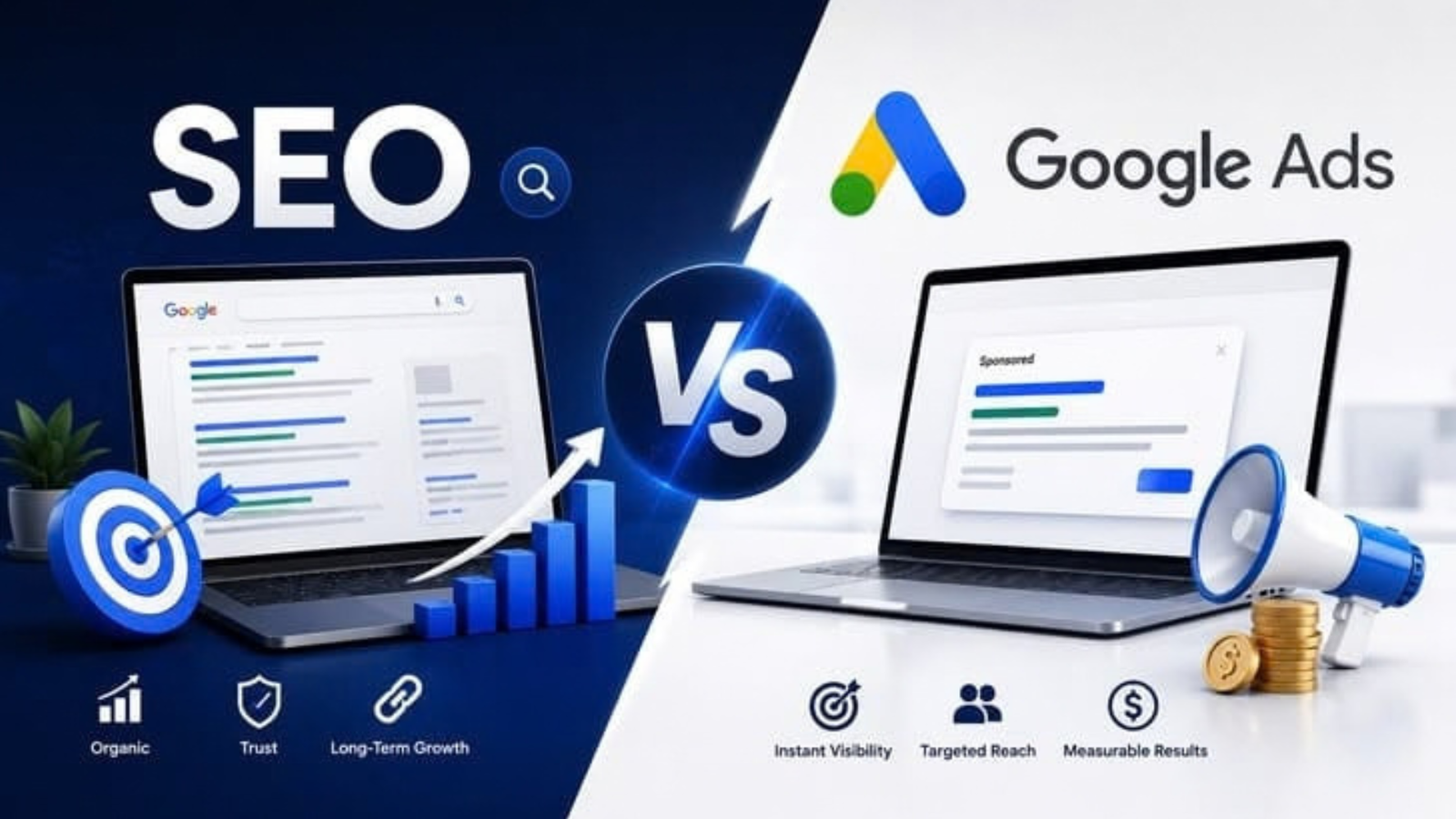
SEO and Google Ads work in very different ways. SEO focuses on improving your website’s organic visibility in search engine results, while Google Ads allows businesses to pay for advertising placements and reach potential customers almost immediately. Both can be effective, but the right strategy depends on your business goals, budget, competition, and how quickly you want to see results.
Understanding the difference between SEO and Google Ads can help you decide where your marketing investment should go.
What Is SEO?
SEO, or Search Engine Optimization, is the process of improving a website so that it can appear more prominently in organic search results.
When someone searches for a product, service, or answer on Google, search engines analyze hundreds of factors to determine which pages should appear in the results. SEO helps businesses make their websites more useful, relevant, technically sound, and trustworthy.
SEO generally includes several areas, such as:
- Keyword research
- On-page optimization
- Technical SEO
- Content creation
- Internal linking
- Website performance optimization
- Local SEO
- Link building and authority development
The goal is not simply to bring more visitors to a website. The goal is to attract relevant visitors who are more likely to be interested in what the business offers.
For example, if you provide digital marketing services and optimize your website for relevant search terms, users searching for those services may discover your business through organic search results.
What Are Google Ads?
Google Ads is Google’s paid advertising platform. It allows businesses to display advertisements when people search for specific keywords or browse websites, apps, YouTube, and other Google properties.
For search campaigns, businesses can bid on keywords that are relevant to their products or services. When a user’s search matches the targeting criteria, an advertisement may appear above or below the organic search results.
For example, a business selling accounting software might run Google Ads for searches such as “accounting software for small business” or “best accounting software.”
Unlike SEO, Google Ads can generate visibility much faster because businesses do not have to wait for organic rankings to develop.
However, paid visibility comes with a cost. Businesses generally pay based on interactions such as clicks, depending on the campaign and bidding model.
SEO vs Google Ads: The Main Difference
The simplest way to understand the difference is this:
SEO earns organic visibility, while Google Ads buys advertising visibility.
SEO requires continuous optimization, useful content, technical improvements, and patience. Google Ads requires advertising budget, campaign management, keyword targeting, ad optimization, and ongoing monitoring.
Neither approach is automatically suitable for every business.
The right choice depends on what you are trying to achieve.
| SEO | Google Ads |
|---|---|
| Focuses on organic search traffic | Focuses on paid traffic |
| Usually takes time to build results | Can generate traffic quickly |
| No direct payment for each organic click | Businesses pay for advertising interactions |
| Results can continue after active optimization | Traffic generally decreases when campaigns stop |
| Builds long-term search visibility | Useful for immediate campaigns and promotions |
| Requires content and technical optimization | Requires budget and campaign management |
How Quickly Can You See Results?
One of the biggest differences between SEO and Google Ads is the time required to generate meaningful results.
Google Ads can start bringing visitors to your website shortly after a campaign is approved and begins running. This makes it useful when a business needs immediate visibility for a product, service, offer, or event.
SEO usually takes longer.
A new website may need time to establish authority, get pages indexed, improve rankings, and build organic traffic. The timeline can vary significantly depending on competition, website quality, industry, content, technical SEO, and the keywords being targeted.
This does not mean SEO is ineffective in the short term. Some improvements can produce relatively quick results, particularly when a website already has authority or has easily fixable technical and on-page issues.
The important difference is that Google Ads can provide immediate paid visibility, while SEO generally requires a longer-term approach.
Which Strategy Costs More?
The cost structure of SEO and Google Ads is different.
With Google Ads, you set an advertising budget and pay for campaign activity according to the selected bidding and billing model. Competitive keywords can become expensive, especially in industries where many businesses are competing for the same search terms.
SEO does not require paying Google for every organic click. However, effective SEO still requires investment.
Businesses may need to spend money on:
- SEO professionals or agencies
- Content creation
- Technical improvements
- Website development
- SEO tools
- Digital PR and link-building activities
So, saying that SEO is “free” would be misleading.
The real difference is how the investment is made.
Google Ads typically requires ongoing advertising expenditure to maintain paid visibility, whereas SEO investment is directed toward improving the website’s long-term organic presence.
SEO Can Build Long-Term Visibility
One of the major advantages of SEO is its potential to create sustainable organic traffic.
Suppose you publish a detailed page targeting an important search query and that page gradually reaches the first page of Google. If it continues to provide useful information and remains competitive, it can attract visitors over an extended period.
That does not mean SEO traffic is guaranteed forever.
Search rankings can change because of algorithm updates, new competitors, changing search behavior, outdated content, technical problems, or changes in search results.
That is why SEO should be treated as an ongoing process rather than a one-time activity.
Businesses need to regularly update important pages, publish useful content, monitor rankings, fix technical issues, and look for new opportunities.
Google Ads Can Support Immediate Business Goals
Google Ads can be particularly useful when speed matters.
Imagine a business launching a new service next month. Waiting several months for organic rankings may not fit the campaign timeline. Google Ads can help the business reach relevant users as soon as the campaign is active.
Paid search can also be useful for:
- Limited-time offers
- Product launches
- Seasonal campaigns
- New services
- Local promotions
- Lead-generation campaigns
- Testing new keywords
- Supporting sales targets
The advantage is control.
You can define budgets, targeting, locations, keywords, ad messaging, landing pages, and campaign schedules.
However, good campaign management is important. Spending money on broad or irrelevant searches can increase costs without producing meaningful business results.
SEO Helps You Understand Search Intent
SEO is not only about ranking for keywords.
A strong SEO strategy considers search intent—the reason behind a user’s search.
For example, someone searching for:
“What is technical SEO?”
is probably looking for information.
Someone searching for:
“technical SEO agency”
may be researching service providers.
Someone searching for:
“hire technical SEO agency”
could have stronger commercial intent.
Understanding these differences allows businesses to create the right content for different stages of the customer journey.
Google Ads also uses search intent, but businesses can use paid campaigns to target commercial searches and test which keywords generate valuable leads or sales.
Google Ads Can Help Test Keywords
One interesting advantage of paid search is that it can provide relatively quick data.
Suppose you are unsure whether a particular group of keywords can generate qualified leads. Instead of waiting months to see how an organic page performs, you can run a controlled advertising campaign and analyze the results.
You can evaluate metrics such as:
- Click-through rate
- Cost per click
- Conversion rate
- Cost per conversion
- Search terms
- Landing page performance
These insights can sometimes help inform broader marketing and SEO decisions.
For example, if certain search terms consistently produce high-quality leads through paid campaigns, those topics may deserve attention in your organic SEO strategy as well.
SEO and Google Ads Work Better Together
The choice does not always have to be SEO or Google Ads.
For many businesses, using both strategies can create a more complete search marketing approach.
SEO can help build long-term organic visibility, while Google Ads can provide immediate visibility for important commercial searches.
For example, a company could use SEO to build organic rankings for informational and commercial keywords while simultaneously running Google Ads for high-value services.
Over time, the business can analyze which keywords, landing pages, and topics generate the best results across both channels.
This creates an opportunity to use paid search data to support SEO decisions and SEO insights to improve paid campaigns.
When Should Your Business Focus More on SEO?
SEO may deserve greater attention when your business is looking for long-term organic growth.
It can be particularly relevant if:
- Your customers regularly use search engines to find products or services
- You operate in a competitive online market
- You want to build organic traffic over time
- You have valuable expertise that can be converted into content
- Your website has existing organic potential
- You want to reduce dependence on paid traffic over the long term
SEO can be especially valuable for businesses that have a large number of relevant topics, products, services, or questions they can target through useful content.
For example, an e-commerce website may create category and product pages, while a professional service business may develop service pages, guides, FAQs, and industry-specific resources.
When Should Your Business Consider Google Ads?
Google Ads may make sense when immediate visibility is important or when you have a clearly defined advertising objective.
It can be useful when:
- You need traffic quickly
- You are launching a new product or service
- You are promoting a limited-time offer
- You operate in a location-specific market
- You want to generate leads from commercial searches
- You want to test keywords or offers
- You have a defined advertising budget
However, Google Ads should not simply be treated as a way to buy more website traffic.
The real objective should be to generate relevant traffic that has a reasonable chance of converting into a business outcome.
What About Local Businesses?
Local businesses often have an opportunity to use both SEO and Google Ads.
Local SEO can help businesses appear in relevant organic search results and Google Maps-related results, depending on the search and business profile.
For example, a person searching for “dentist near me” or “digital marketing agency in Delhi” may be looking for a local provider.
Google Ads can also help local businesses target specific geographic areas and relevant search terms.
A local business might therefore use SEO to build long-term visibility while using paid search to generate immediate exposure for specific services.
SEO vs Google Ads for New Businesses
New businesses often face a difficult question: should they invest in SEO or start with Google Ads?
There is no universal answer.
A new business that needs leads immediately may benefit from paid advertising while its website and organic presence are being developed.
At the same time, starting SEO early can help build a foundation for future organic growth.
This can include creating optimized service pages, establishing a technical SEO foundation, publishing useful content, improving local visibility, and building the website’s authority.
Starting SEO early also means the business does not have to wait until it urgently needs organic traffic before beginning the process.
What If Your Budget Is Limited?
Budget plays an important role in the decision.
If your advertising budget is very limited, continuously running competitive Google Ads campaigns may not be sustainable.
In that situation, investing in SEO fundamentals and creating valuable content may provide a more appropriate long-term approach.
However, SEO also requires resources. If the business does not have the expertise or time to manage SEO internally, professional SEO services may be required.
A practical approach is to identify your most important business goals and allocate resources based on expected outcomes rather than choosing a channel simply because it appears cheaper.
Which One Produces Better Conversions?
Conversion performance depends on several factors, so there is no universal conversion winner between SEO and Google Ads.
A campaign may receive thousands of visitors but generate few leads if the traffic is poorly targeted or the landing page is weak.
Similarly, an organic page can rank well but produce limited business value if it targets informational searches that have little commercial intent.
Conversion performance can be influenced by:
- Search intent
- Keyword selection
- Landing page quality
- Website experience
- Offer
- Pricing
- Brand trust
- Industry
- Competition
- Audience
- Call-to-action
This is why traffic should not be the only SEO or Google Ads metric a business tracks.
Leads, sales, revenue, customer acquisition cost, and return on marketing investment may provide a more useful picture.
How to Decide Between SEO and Google Ads
Instead of asking which strategy is universally better, start with your business objectives.
Ask yourself:
Do I need results immediately?
If yes, Google Ads may provide faster visibility.
Am I trying to build a long-term source of organic traffic?
If yes, SEO can become an important part of your strategy.
Do I have a limited-time promotion?
Paid advertising may be useful because the campaign can be started and stopped according to the promotion.
Do I want to build authority around my industry?
SEO and content marketing can help create a long-term search presence.
Do I want both immediate and long-term visibility?
Using SEO and Google Ads together may be appropriate.
A Balanced Search Marketing Strategy
For many businesses, the most practical approach is not to treat SEO and Google Ads as competing channels.
Instead, they can support different stages of growth.
Google Ads can help bring immediate targeted traffic while SEO works in the background to develop organic visibility.
As organic rankings improve, a business can evaluate its paid campaigns and adjust spending based on performance. Some keywords may continue to justify paid advertising, while others may receive sufficient organic visibility.
This creates a more flexible search marketing strategy.
The key is to measure both channels based on business outcomes rather than traffic alone.
Final Thoughts
SEO and Google Ads serve different purposes, but both can contribute to business growth when used correctly.
SEO is generally a long-term investment in organic visibility, content, technical performance, and search authority. Google Ads is a paid advertising channel designed to provide targeted visibility and traffic based on an allocated advertising budget.
If your priority is immediate visibility, Google Ads can play an important role. If your goal is to develop sustainable organic search traffic, SEO deserves consistent attention.
For many businesses, the strongest approach may involve both.
The right strategy should ultimately be based on your target audience, competition, budget, business model, customer journey, and growth objectives. Instead of choosing a channel simply because it is popular, evaluate how each one contributes to the results your business actually needs.
Frequently Asked Questions
Is SEO better than Google Ads?
SEO and Google Ads have different purposes. SEO focuses on organic search visibility and long-term growth, while Google Ads provides paid visibility and can generate traffic more quickly. The appropriate option depends on your business goals, budget, competition, and timeline.
Is Google Ads faster than SEO?
Generally, yes. Google Ads can start generating paid traffic after a campaign becomes active and eligible to serve. SEO usually requires more time to improve rankings and build organic visibility.
Can SEO and Google Ads be used together?
Yes. Many businesses use Google Ads for immediate paid visibility while investing in SEO for long-term organic growth. Data from one channel can also provide useful insights for the other.
Is SEO free?
SEO does not involve paying Google for each organic click, but it is not necessarily free. Businesses may need to invest in SEO professionals, content, website development, tools, technical improvements, and other optimization activities.
How long does SEO take to show results?
There is no fixed timeline. Results depend on factors such as website authority, competition, keyword difficulty, content quality, technical SEO, industry, and the current condition of the website.
How much should a business spend on Google Ads?
There is no universal budget that works for every business. The appropriate budget depends on factors such as keyword costs, competition, conversion rates, customer value, geographic targeting, and business objectives.
Can Google Ads help SEO?
Google Ads does not directly improve organic rankings simply because you advertise. However, paid campaigns can provide useful data about keywords, search behavior, advertisements, and landing pages that may inform broader SEO and marketing decisions.
Should a small business invest in SEO or Google Ads?
A small business should consider its goals and available resources. Google Ads may be useful when immediate leads or visibility are required, while SEO can help develop long-term organic visibility. In some cases, combining both approaches may be appropriate.
What should a business track for SEO and Google Ads?
Businesses should look beyond website traffic. Useful metrics can include qualified leads, conversions, conversion rate, cost per acquisition, revenue, organic visibility, keyword performance, and return on marketing investment.
Which strategy should your business choose?
There is no single strategy that fits every business. Consider how quickly you need results, how customers find your business, your competition, available budget, and whether your priority is immediate visibility, long-term organic growth, or both. A strategy based on these factors can help you use SEO and Google Ads more effectively.