
0 views
Search is changing.
For years, people used search engines in a familiar way. They typed a question, looked through a list of results, clicked a few websites, and found the information they needed.
Today, that process is becoming different.
With AI Overviews, search engines can provide AI-generated summaries directly on the results page. Instead of opening several websites, users may get a useful answer before they click anywhere.
This does not mean traditional search is going away. People still visit websites to read detailed information, compare products, research services, and make decisions.
What is changing is how people decide when and where to click.
For businesses, this shift is important. SEO is no longer just about getting a website to rank on the first page. It is also about being visible when people use AI-assisted search and giving them a reason to visit your website.
Let’s look at how AI Overviews are changing search behavior and what businesses can do about it.
What Are AI Overviews?
AI Overviews are AI-generated summaries that can appear at the top of search results for certain queries.
Instead of showing only a list of webpages, the search engine can summarize information from different sources and give the user a quick overview of the topic.
For example, someone might search:
“How can SEO help a small business?”
With traditional search, the person would usually see several webpages and choose which one to open.
With an AI Overview, the search experience can begin with a summarized answer. The user may then look at the sources, ask another question, or visit a website for more information.
This makes search feel less like a list of links and more like a conversation.
That change is important because the user’s journey can now start before they visit a website.
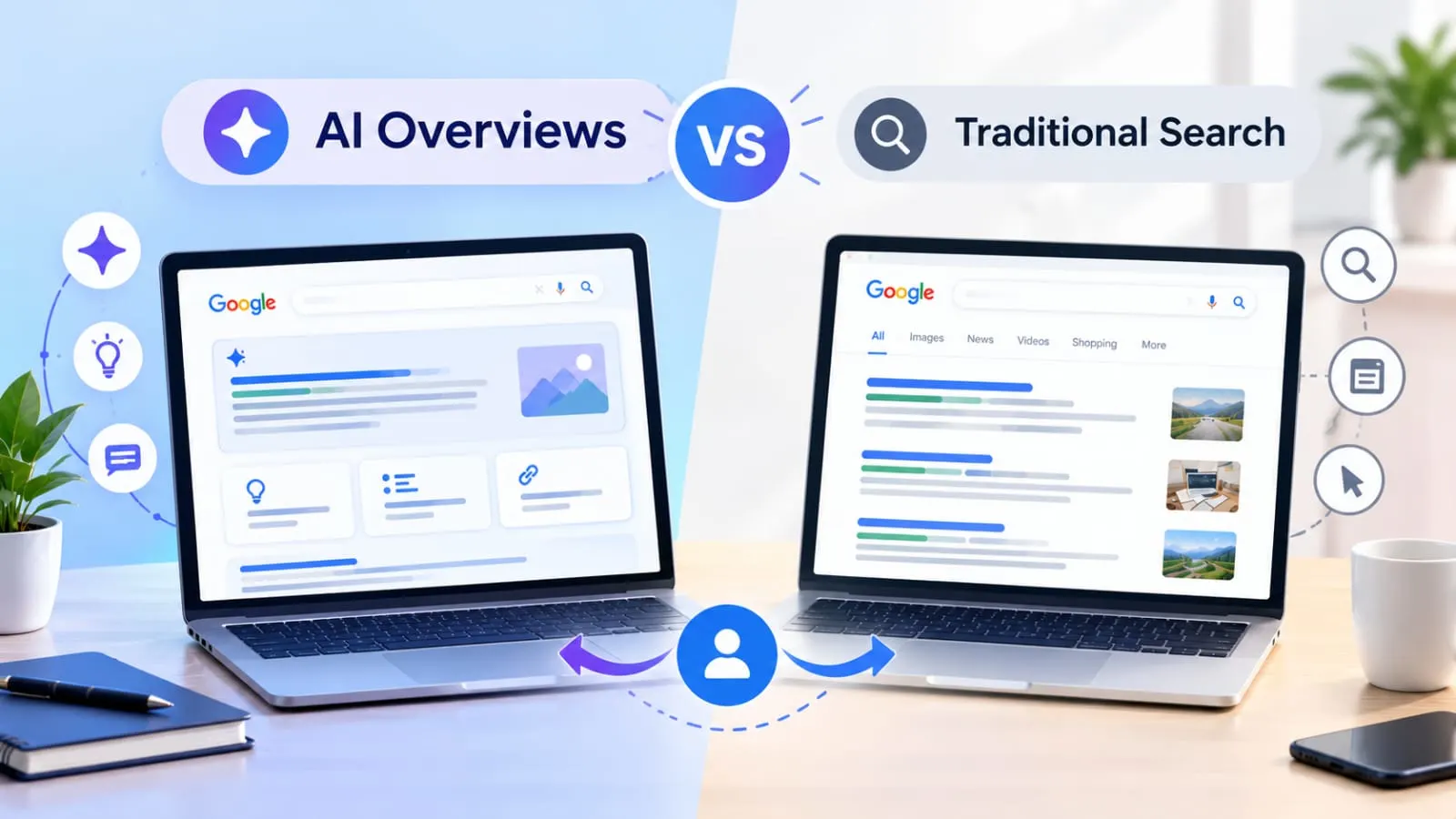
Traditional Search and AI Overviews Work Differently
Traditional search has a fairly simple process:
Search → Review results → Click a website → Read → Compare information
AI-assisted search can look more like this:
Search → Read the summary → Explore sources → Ask another question → Visit a website if needed
The difference may seem small, but it can have a major effect on user behavior.
A person looking for a quick fact may not need to click a website at all.
But someone researching a complicated topic may still want to read a full article, check examples, compare options, or find a service provider.
This means businesses need to understand why people search, not just what they search for.
Why Are People Changing the Way They Search?
The simple answer is convenience.
People have become used to getting information quickly. If a question can be answered in a few seconds, most users do not want to spend ten minutes opening different websites.
AI Overviews can make that process easier.
But convenience is only one part of the change.
Search is also becoming more conversational.
Instead of typing short phrases such as:
“SEO benefits”
a user might ask:
“How can SEO help a small business get more customers?”
The second search gives more context.
It tells us that the person is probably interested in business growth, not just the definition of SEO.
This is why marketers need to focus on search intent.
Search Intent Is Becoming More Important
Search intent is the reason behind a search.
Two people can use similar keywords but want completely different things.
For example, someone searching for “SEO audit” might want to know:
- What an SEO audit is
- How to perform one
- Which tools to use
- How much an audit costs
- Whether they should hire an SEO professional
A single page may not satisfy every type of intent.
A better approach is to create useful content for different stages of the customer’s journey.
You might have an educational article explaining how an SEO audit works ,another guide covering common technical SEO problems, and a service page for professional SEO audits.
These pages can then be connected with internal links.
This gives users a natural path from learning to taking action.
Users Are Becoming More Selective About Clicking
One of the biggest changes in search behavior is that users may click fewer results for simple questions.
Think about a search such as:
“What is a meta description?”
If the search results already explain the answer, the user may not need to open an article.
But now consider a different search:
“How do I write meta descriptions for an e-commerce website?”
That person probably needs more than a definition.
They may want examples, best practices, mistakes to avoid, and practical advice.
That is where a good website can still win the click.
The lesson for businesses is simple:
Do not create content that only gives the most basic answer.
Give readers something useful beyond the quick summary.
That could be:
- Real examples
- Step-by-step instructions
- Original research
- Expert advice
- Case studies
- Templates
- Comparisons
- Industry-specific information
- Practical tips
When your content solves a real problem, users have a reason to keep reading.
AI Search Does Not Make Good Content Less Important
It may seem that AI-generated answers make website content less valuable.
The opposite can be true.
Good AI-powered search experiences depend on useful information from websites and other sources. That makes the quality of the information available online important.
For businesses, this means creating content that is clear, accurate, useful, and genuinely relevant to the audience.
But there is an important distinction.
Longer content is not automatically better content.
A 2,500-word article filled with repetition is not more useful than a clear 1,200-word article that answers the reader’s questions properly.
Focus on usefulness rather than word count.
A good article should answer the main question, explain the topic clearly, cover important related questions, and help the reader decide what to do next.
Search Is Becoming More Conversational
AI has also made search feel more like a conversation.
A user may start with a broad question and then narrow it down.
For example:
“What is content marketing?”
Then:
“How does content marketing generate leads?”
Then:
“What type of content works best for B2B companies?”
And finally:
“How can I measure content marketing performance?”
Each question builds on the previous one.
This creates a longer search journey.
Businesses should think about this when planning content. Instead of creating separate articles that have no connection, build groups of related content around important topics.
This is often called a topic cluster.
For example, a digital marketing website could have a main guide about content marketing supported by articles about content strategy, keyword research, content promotion, lead generation, and content analytics.
You can then use [a strong internal linking strategy] to connect those pages.
Internal Linking Matters More in This New Search Environment
Internal linking has always been an important part of SEO.
It becomes even more useful when your website contains a lot of related information.
Imagine a visitor is reading an article about SEO analytics.
During the article, they want to learn more about measuring website performance.
A natural internal link to digital marketing analytics and marketing performance gives them the next resource they need.
Later, they may want to learn about first-party data. Another link to [first-party data in digital marketing] can continue the journey.
This is much better than leaving readers at the end of an article with nowhere useful to go.
Internal links should always have a purpose.
Use descriptive anchor text that tells readers what they will find.
Instead of:
Click here
use:
learn how to measure SEO performance
or:
read our guide to first-party data
This makes the experience clearer and more useful.
AI Overviews May Change How We Measure SEO Success
For a long time, SEO reporting focused heavily on rankings and organic traffic.
Those metrics still matter.
But AI-assisted search means businesses may need to look at a wider picture.
For example, you can also consider:
- Organic conversions
- Leads from search
- Branded searches
- Engagement with important pages
- Returning visitors
- Visibility for important topics
- Assisted conversions
- Search impressions
A website might receive fewer clicks for simple informational searches but still gain valuable visibility.
For example, someone may discover a company while researching a topic, remember the brand, and search for it later.
The first search did not create a direct website visit, but it may have influenced the final conversion.
This is why [digital marketing analytics] should look beyond traffic alone.
What Makes People Click a Website?
If users can get a quick answer from an AI Overview, why would they visit a website?
Usually, they want something deeper.
People are more likely to click when they need:
More detailed information
A short summary may explain the basics, but a detailed guide can answer more specific questions.
Real examples
Examples make information easier to understand and apply.
Expert knowledge
Users may want advice from someone with experience in a particular industry.
Original research
Statistics, surveys, case studies, and original findings can provide value that a generic summary cannot.
Products or services
When someone is ready to buy or contact a business, they need to visit a website.
Practical resources
Templates, calculators, checklists, tools, and detailed tutorials can encourage users to click.
This gives businesses a clear direction.
Create content that is worth visiting.
How Businesses Can Adapt Their SEO Strategy
Businesses do not need to throw away their existing SEO strategy.
The fundamentals still matter.
Instead, they should improve those fundamentals while creating content that matches changing search behavior.
Here are some practical steps.
Understand the questions your audience asks
Do not focus only on high-volume keywords.
Look at the questions customers ask before, during, and after they consider buying your product or service.
These questions can become useful content ideas.
Match content to search intent
Before creating a page, ask what the searcher actually wants.
Are they looking for information?
A comparison?
A product?
A service?
A solution to a problem?
Your content should match that intent.
Answer questions clearly
Do not hide the main answer under a long introduction.
Give readers the information they came for, then expand on it.
This improves readability and creates a better user experience.
Add original value
Look for ways to make your content different from the pages already ranking.
Use examples from your industry.
Add practical advice.
Include original data when available.
Share lessons from real experience.
The more useful the content is, the more reason users have to visit it.
Build connected content
Do not treat every blog post as a separate project.
Create related content around your main topics and connect those pages with internal links.
This can help both users and search engines understand your website better.
Keep important pages updated
Search behavior changes.
Information changes.
Your business changes.
Review your important content regularly and update outdated information, examples, statistics, and recommendations.
AI Overviews and Different Types of Search
The impact of AI-powered search will not be the same for every search.
Informational searches
These may see the biggest change.
For simple questions, users may get enough information directly in the search results.
That means basic “what is” content needs to provide additional value if it wants to attract clicks.
Commercial searches
People researching products or services often need more information before making a decision.
Reviews, comparisons, detailed guides, and case studies can become especially useful.
Transactional searches
When someone is ready to buy, book, contact, or sign up, they still need a website or another platform to complete the action.
This is why strong service pages and product pages remain important.
Local searches
Local businesses can also benefit from strong online visibility.
Someone looking for a nearby service may use search results, maps, reviews, and business websites before making a decision.
A well-optimized website should therefore work together with a strong local SEO presence.
Website Structure Still Matters
As search becomes more complex, your website needs to make sense to both users and search engines.
Important pages should be easy to find.
Related pages should be connected.
Navigation should be clear.
URLs should be descriptive.
A logical SEO-friendly website structure can make it easier for visitors to move from one topic to another.
For example, a digital marketing website could organize content around:
SEO
- Technical SEO
- Local SEO
- On-page SEO
- SEO analytics
Content Marketing
- Content strategy
- Blogging
- Topic clusters
- Content promotion
Digital Marketing
- Social media
- Analytics
- First-party data
- Lead generation
This kind of structure creates clear relationships between pages.
It also makes internal linking easier.
The Human Side of Search Is Still Important
With so much discussion around AI, it is easy to forget one important fact:
People are still the ones using search.
They have questions.
They have problems.
They have budgets.
They have preferences.
And they make decisions based on the information they trust.
That means businesses should not try to write content only for algorithms or AI systems.
Write for the person sitting behind the search box.
Use natural language.
Explain complicated ideas simply.
Avoid unnecessary jargon.
Give examples.
Be honest when something has limitations.
Make it easy for readers to find the next step.
This is what makes content feel human.
What the Future of Search Could Look Like
Search is likely to become more conversational and personalized.
People may ask longer questions, refine their searches through follow-up queries, and expect search engines to understand context.
But traditional search results will still have an important role.
There will always be situations where people want to:
- Visit a specific website
- Read a full article
- Compare products
- Check reviews
- Contact a company
- Make a purchase
- Read expert opinions
- Explore detailed information
The future is therefore unlikely to be simply AI search versus traditional search.
It is more likely to be a combination of both.
The user will decide how much information they need.
What Businesses Should Do Now
The best response to changing search behavior is not to chase every new SEO trend.
Start with your audience.
Find out what they search for.
Understand what they want.
Review the content you already have.
Then ask whether your pages actually help them.
Look for content that is too basic, outdated, repetitive, or disconnected from the rest of your website.
Improve those pages.
Create supporting content.
Add relevant internal links.
Make important information easy to find.
And most importantly, give people a reason to visit your website even after they have seen a quick answer in search.
That reason could be expertise, original information, useful examples, a helpful tool, a product, or a service.
Frequently Asked Questions
What is the difference between AI Overviews and traditional search?
Traditional search mainly presents a list of webpages for users to explore. AI Overviews can provide a summarized answer directly within the search results, giving users information before they decide whether to visit a website.
Are AI Overviews replacing traditional search results?
No. Traditional organic results remain an important part of search. AI Overviews add another layer to the search experience rather than completely replacing website listings.
Will AI Overviews reduce organic website traffic?
They can reduce clicks for some simple informational searches because users may find enough information without opening a webpage. However, people still visit websites when they need detailed information, expert advice, products, services, or practical resources.
Should businesses change their SEO strategy because of AI Overviews?
Businesses should adapt rather than abandon traditional SEO. Technical SEO, search intent, useful content, internal linking, website structure, and good user experience remain important. The focus should also shift toward creating content that offers value beyond a basic answer.
Is keyword research still important?
Yes. Keyword research remains useful for understanding what people search for. However, businesses should combine keyword research with search intent, related questions, topics, and the actual needs of their audience.
How can businesses make their content more useful for AI-powered search?
Create clear, accurate, well-organized content. Answer questions directly, cover related topics, include useful examples, add original insights, and connect related pages through relevant internal links.
Does internal linking help with AI search?
Internal linking can help create clear relationships between pages on a website. It also makes it easier for visitors to discover related information and continue researching a topic.
Is long-form content still useful?
Yes. Long-form content can be valuable when the topic requires detailed explanation. However, length alone does not make content better. The information should be useful, organized, and easy to read.
What type of content is most likely to attract website visitors?
Content that provides something beyond a quick answer can be especially valuable. Examples include detailed guides, case studies, original research, comparisons, expert advice, practical tutorials, tools, and industry-specific resources.
Conclusion
AI Overviews are changing how people search, but they are not making traditional SEO irrelevant.
The biggest change is that users can now get more information before they click a website.
That means businesses need to think differently about what earns a click.
Basic information may be enough for a quick search, but people will still look for websites when they need depth, expertise, examples, products, services, and trustworthy information.
The strongest strategy is to focus on the fundamentals while adapting to new search behavior.
Understand search intent. Create genuinely useful content. Build related topics. Use internal links naturally. Keep your website organized. And always write for the person who is actually searching.
The future of SEO is not about choosing between AI Overviews and traditional search.
It is about making your website valuable enough to remain part of the user’s journey, no matter how that journey begins.