
1 view
A landing page can attract plenty of visitors from Google but generate very few enquiries. Another page may convince visitors to take action but struggle to appear in search results. For businesses investing in digital marketing, this creates an important question: should you focus on landing page SEO or conversion optimization?
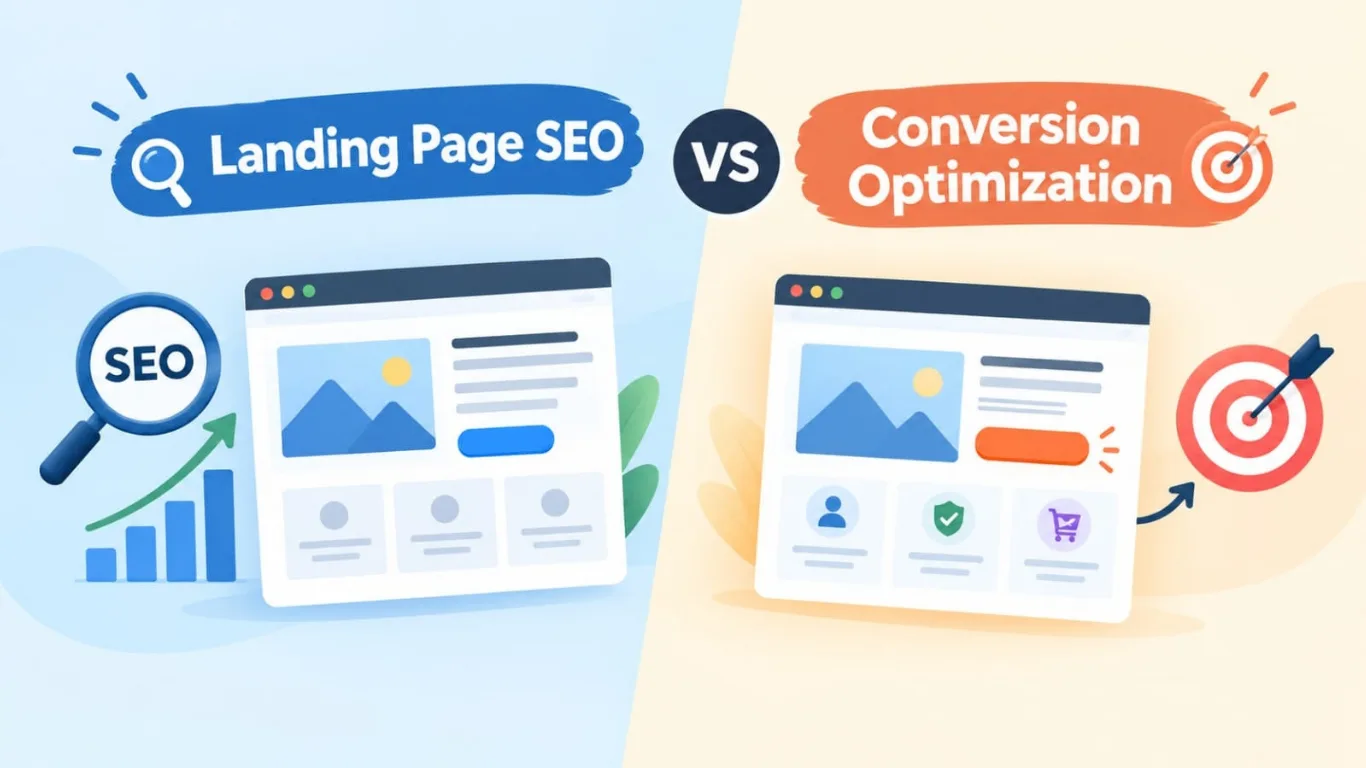
The answer depends on what your page needs to achieve. Landing page SEO helps potential customers discover your page, while conversion optimization helps turn those visitors into leads, customers, or enquiries. Both play an important role in building a website that supports business growth.
Many businesses make the mistake of treating search visibility and conversions as separate goals. They invest in keywords and content to attract traffic but overlook the user experience. Others spend time improving headlines, forms, and buttons without addressing why their landing pages receive so few visitors in the first place.
A successful landing page needs both visibility and usability. It should attract the right audience, provide relevant information, build trust, and make the next step clear.
In this guide, we will explain landing page SEO vs conversion optimization, compare their main differences, discuss common mistakes, and share practical strategies for improving both.
What Is Landing Page SEO?
Landing page SEO is the process of optimizing a landing page so that it can appear in relevant search engine results and attract organic traffic. The objective is to help potential customers find your business when they search for products, services, or solutions related to your offering.
A landing page usually focuses on one particular service, product, campaign, or audience. For example, a digital marketing company might create a landing page for SEO services, while a software business might develop a page promoting a free product demonstration.
Landing page SEO makes these pages easier for search engines to understand and more relevant to the people searching for them.
Key elements of landing page SEO
1. Keyword research
Keyword research helps you understand how your target audience searches for your services. A business offering website development might target phrases such as “website development services” or “website design for small businesses.”
Choose a primary keyword that reflects the page’s main purpose. Use it naturally in the page title, main heading, introduction, and relevant subheadings.
Related terms can provide additional context, but avoid repeating keywords simply to increase their frequency. Content should sound natural and answer the visitor’s questions.
Search intent refers to the reason behind a user’s search. Some people want information, while others are comparing providers or preparing to make a purchase.
For example, someone searching for “what is SEO” probably wants an explanation. A person searching for “SEO services for small businesses” may be looking for a service provider.
Your landing page should match that intent. If visitors expect information but find only promotional content, they may leave without engaging.
3. Helpful content
A landing page should explain what you offer, who it helps, and why it is useful. Depending on the service, it may also need to answer questions about pricing, process, benefits, timelines, or expected outcomes.
Useful content helps visitors make informed decisions and gives search engines a clearer understanding of the page.
Technical SEO ensures that search engines can access and understand your landing page. Important considerations include indexability, mobile usability, page speed, URL structure, canonical tags where appropriate, and crawlability.
Even well-written content may struggle to perform if technical issues prevent search engines from accessing or indexing the page correctly.
Internal links connect your landing page with other relevant pages on your website. They help visitors explore related information and allow search engines to discover the relationships between your pages.
For example, a landing page about SEO services could link to an educational article about keyword research or a related service page. SEO services page is a relevant example of a destination for visitors exploring search optimization.
What Is Conversion Optimization?
Conversion optimization, also known as conversion rate optimization (CRO), is the process of improving a webpage so that more visitors complete a desired action.
The action depends on the business objective. For an e-commerce website, it might be completing a purchase. For a service-based business, it could mean submitting an enquiry, requesting a quotation, or booking a consultation.
Conversion optimization focuses on the visitor’s experience after arriving on a page. It looks at how clearly the offer is communicated, whether visitors trust the business, and whether anything makes the next step unnecessarily difficult.
Key elements of conversion optimization
1. A clear value proposition
Visitors should understand what you offer and why it matters within a few seconds.
For example, “Generate More Qualified Leads With Digital Marketing” communicates a specific benefit. A vague headline such as “Welcome to Our Website” provides little information about what makes the offer useful.
A strong value proposition connects the visitor’s problem with the solution your business provides.
2. Effective calls to action
A call to action (CTA) tells visitors what to do next. Examples include “Request a Quote,” “Book a Consultation,” and “Start Your Free Trial.”
The CTA should be visible, easy to understand, and relevant to the visitor’s needs. A person researching a high-value business service may prefer to book a consultation rather than make an immediate purchase.
3. Simple forms
Long or confusing forms can discourage potential customers from completing an enquiry. Ask only for the information your business needs at that stage.
For example, a consultation form might request a name, business email address, and brief description of the requirement. You can collect additional details during a follow-up conversation.
4. Trust signals
Visitors may hesitate to take action if they are unsure whether a business is reliable. Genuine testimonials, relevant case studies, transparent contact information, and clear service descriptions can help address those concerns.
Trust signals should be accurate and relevant. Avoid unsupported claims or exaggerated promises that could undermine credibility.
5. Testing and analysis
Conversion optimization should be based on evidence rather than personal preference. Analytics, customer feedback, usability testing, and A/B testing can help identify areas where visitors struggle.
For example, if visitors frequently begin a form but do not complete it, investigate whether the form is too long, difficult to use, or asking for unnecessary information.
Landing Page SEO vs Conversion Optimization: Key Differences
Although landing page SEO and conversion optimization often work on the same webpage, their main objectives differ.
| Comparison | Landing Page SEO | Conversion Optimization |
|---|---|---|
| Primary goal | Improve search visibility and relevant organic traffic | Increase the proportion of visitors who take action |
| Main focus | Keywords, search intent, content, technical SEO | User experience, messaging, trust, and friction |
| Audience | People discovering the page through search | Visitors arriving from search, ads, social media, email, and other channels |
| Common activities | Keyword research, title optimization, internal linking, technical checks | CTA improvements, form optimization, usability testing, A/B testing |
| Key metrics | Organic clicks, impressions, rankings, qualified traffic | Conversion rate, completed forms, purchases, qualified enquiries |
| Main challenge | Attracting the right audience | Encouraging visitors to complete the desired action |
| Typical timeline | Often a longer-term process | Depends on traffic, testing opportunities, and the changes made |
| Main question | Can potential customers find the page? | Can visitors understand the offer and take the next step? |
The simplest way to understand the difference is that SEO helps people find your landing page, while conversion optimization helps the page turn their interest into action.
Neither strategy replaces the other. A page can rank well but generate few leads. Likewise, a page can convert visitors effectively but receive very little organic traffic.
Why Landing Page SEO Matters for Business Growth
Search engines can connect your business with people who are actively looking for a solution. When a landing page targets relevant searches, it creates an opportunity to attract visitors who already have an interest in your product or service.
It attracts relevant traffic
A large number of visitors does not automatically mean better business results. If most visitors have no interest in your offering, the traffic may generate little value.
Keyword research and search intent help you create content for people who are more likely to need your services.
It supports long-term visibility
Paid advertising can generate visits while a campaign is running. Organic SEO can continue attracting visitors over time, although results depend on competition, website quality, search demand, and other factors.
Maintaining useful, relevant landing pages can support your wider SEO strategy and create additional opportunities for potential customers to discover your business.
It strengthens your website structure
Landing pages can work alongside service pages and educational content to build a more useful website.
For example, a page promoting SEO services could connect to articles about technical SEO, keyword research, and local search optimization. These internal links give visitors additional resources and help establish clear relationships between related topics.
Why Conversion Optimization Matters
Attracting visitors is only one part of digital marketing. Businesses also need to provide an experience that makes it easy for those visitors to understand the offer and take action.
It helps you get more value from existing traffic
Imagine a landing page receives 1,000 visitors per month and converts 2% of them. That produces 20 conversions.
If improvements increase the conversion rate to 3%, the same traffic would produce 30 conversions.
This example illustrates the potential impact of conversion optimization. Actual results will vary depending on traffic quality, the offer, the audience, and the changes made.
It removes unnecessary barriers
Visitors may leave a page because the message is confusing, the form is difficult to complete, or the next step is unclear.
Improving navigation, simplifying forms, clarifying the offer, and making the CTA more visible can reduce these barriers.
It helps you understand customer needs
Customer questions and behaviour can reveal what people need before making a decision. They may want information about pricing, service coverage, implementation, timelines, or expected results.
Answering these questions on the landing page can make the decision process easier and help generate more informed enquiries.
How to Combine Landing Page SEO and Conversion Optimization
The best approach is to plan for search visibility and conversions together. Instead of treating them as separate projects, build landing pages that meet user needs from discovery through to action.
1. Understand your audience and search intent
Start by identifying your target audience, the problem they want to solve, and the search terms they are likely to use.
Determine whether visitors are researching a topic, comparing services, or preparing to purchase. Then create a landing page that matches their expectations.
A page promoting a specific service should explain that service clearly instead of forcing visitors to navigate through unrelated information.
2. Create a clear content structure
Organize the page so visitors can quickly find the information they need.
A useful landing page structure may include:
- A descriptive headline and value proposition
- A short introduction to the offer
- The main benefits and relevant features
- Evidence of credibility
- Answers to common customer questions
- A clear call to action
- Contact or enquiry details
Use descriptive headings and include relevant keywords naturally. The page should be easy to scan without sacrificing useful detail.
3. Improve mobile usability and page speed
Landing pages should work smoothly on mobile devices as well as desktop screens. Text should be readable, buttons should be easy to tap, and forms should not require unnecessary effort.
Review page performance and address issues such as oversized images, unnecessary scripts, and poorly implemented elements.
A fast, usable page supports a better visitor experience and can help prevent avoidable drop-offs.
4. Make the next step obvious
Once visitors understand your offer, they should know what to do next.
Choose a CTA that matches the offer and the visitor’s likely stage in the buying journey. A business promoting a complex service might offer a consultation, while a company sharing an educational resource might ask visitors to download a guide.
Avoid overwhelming visitors with multiple competing actions. Make the primary next step clear.
5. Track traffic and business outcomes
Measure how visitors discover your landing page and what they do after arriving.
Search data can show whether the page is attracting relevant queries. Analytics can help you understand engagement and conversion behaviour. CRM or sales data can reveal whether enquiries become qualified leads or customers.
For a broader view of your marketing activity, explore digital marketing .
Common Mistakes to Avoid
Even well-designed landing pages can underperform when SEO and conversion goals are not considered together.
Keyword stuffing: Repeating the same keyword excessively makes content awkward. Use your primary phrase naturally and focus on answering the visitor’s questions.
Focusing only on traffic: High traffic does not necessarily mean the page is attracting the right audience. Review search intent, lead quality, and the relevance of your visitors.
Using unclear CTAs: Generic wording can leave visitors unsure about what happens next. Choose specific language that explains the action.
Making forms unnecessarily complicated: Requesting too much information too early can discourage potential customers. Keep forms as simple as your business process allows.
Changing too many elements at once: If you redesign the page, rewrite the headline, and replace the form simultaneously, it may be difficult to determine which change influenced performance. Where possible, test clear hypotheses and document the results.
Ignoring lead quality: A higher conversion rate is not always better if the additional enquiries are unlikely to become customers. Measure qualified leads and business outcomes alongside conversion volume.
How to Measure Landing Page SEO and Conversion Performance
SEO and conversion optimization require different but connected measurements.
For landing page SEO, monitor:
- Organic impressions and clicks
- Search click-through rate
- Relevant search queries and ranking trends
- Organic landing-page visits
- Qualified organic traffic
- Technical issues affecting indexing or usability
For conversion optimization, monitor:
- Conversion rate
- Form starts and completions
- CTA interactions
- Qualified enquiries
- Purchases or booked consultations
- Revenue and acquisition costs, where applicable
A basic conversion rate formula is:
Conversion rate = (Number of conversions ÷ Number of visitors) × 100
For example, if 40 people complete a desired action out of 2,000 visitors, the conversion rate is 2%.
Use consistent measurement definitions when comparing results. Some analytics reports calculate conversion rates using users, while others use sessions. Comparing different definitions can lead to misleading conclusions.
Tools such as Google Analytics and Google Search Console can help you understand visitor behaviour and search visibility. Make sure conversion events are configured correctly so the information you collect reflects actual actions.
Landing Page Optimization Checklist
Use this checklist when creating a new landing page or improving an existing one.
- Identify the target audience and search intent.
- Select a primary keyword and relevant supporting terms.
- Write a descriptive title tag and clear main heading.
- Explain the offer and its benefits.
- Provide accurate, useful content that answers customer questions.
- Add relevant internal links with descriptive anchor text.
- Check mobile usability and page speed.
- Include a clear and relevant CTA.
- Keep forms simple and easy to complete.
- Include genuine trust signals.
- Set up analytics and conversion tracking.
- Review lead quality as well as conversion volume.
- Test improvements based on evidence.
Not every landing page needs the same design. A page promoting a low-cost product may require a different approach from one promoting a complex business service. Let the audience, offer, and performance data guide your decisions.
Frequently Asked Questions
1. What is the main difference between landing page SEO and conversion optimization?
Landing page SEO focuses on improving visibility in relevant search results and attracting organic traffic. Conversion optimization focuses on encouraging visitors to complete a desired action, such as submitting a form or making a purchase. SEO helps people discover your page, while conversion optimization improves the experience after they arrive.
2. Can a landing page rank well but have a low conversion rate?
Yes. A page can rank for relevant keywords but still generate few enquiries if its message is unclear, the offer does not meet visitor expectations, or the form is difficult to complete. Review search intent, page content, CTA placement, trust signals, and usability to identify possible improvements.
3. Does conversion optimization improve SEO rankings?
Conversion optimization does not automatically improve rankings, and a higher conversion rate is not a direct substitute for SEO. However, improvements such as clearer content, better mobile usability, and stronger page performance can support a better overall website experience. SEO and conversion optimization should be measured separately while working toward shared business goals.
4. Which should a business prioritize: SEO or conversion optimization?
The priority depends on the page’s current performance. If a landing page attracts little relevant organic traffic, review keyword targeting, search intent, and technical SEO. If qualified visitors arrive but rarely take action, investigate conversion barriers. Businesses often benefit from addressing the most significant problem first while continuing to monitor both areas.
5. How often should landing pages be optimized?
Review landing-page performance regularly, but make changes when there is a clear reason to do so. Look for changes in traffic, conversions, customer feedback, or campaign performance. After making an improvement, allow enough time and collect sufficient data to evaluate its impact. Low traffic may make some tests inconclusive.
6. What is a good landing page conversion rate?
There is no universal conversion rate that works for every business. Results vary by industry, traffic source, audience, offer, and conversion type. Establish a baseline for your own page, compare similar traffic segments, and measure whether changes improve qualified enquiries, sales, or another meaningful business outcome.
Conclusion
Landing page SEO and conversion optimization have different objectives, but both are essential for creating landing pages that support business growth. SEO helps potential customers discover your page through relevant searches, while conversion optimization makes it easier for those visitors to understand your offer and take action.
The most effective strategy connects both from the beginning. Research search intent, create useful content, improve page speed and mobile usability, and make the next step clear. Then use analytics, customer feedback, and testing to understand where visitors experience difficulty and which improvements are worth prioritizing.
Avoid measuring success through rankings, traffic, or conversion rates alone. Look at the complete customer journey, from search visibility to qualified enquiries and revenue.
ASINFOVISION supports businesses with SEO and integrated digital marketing services that help strengthen online visibility and improve marketing performance. By balancing discoverability with a helpful user experience, businesses can build landing pages that do more than attract visitors—they can turn relevant interest into meaningful action.