


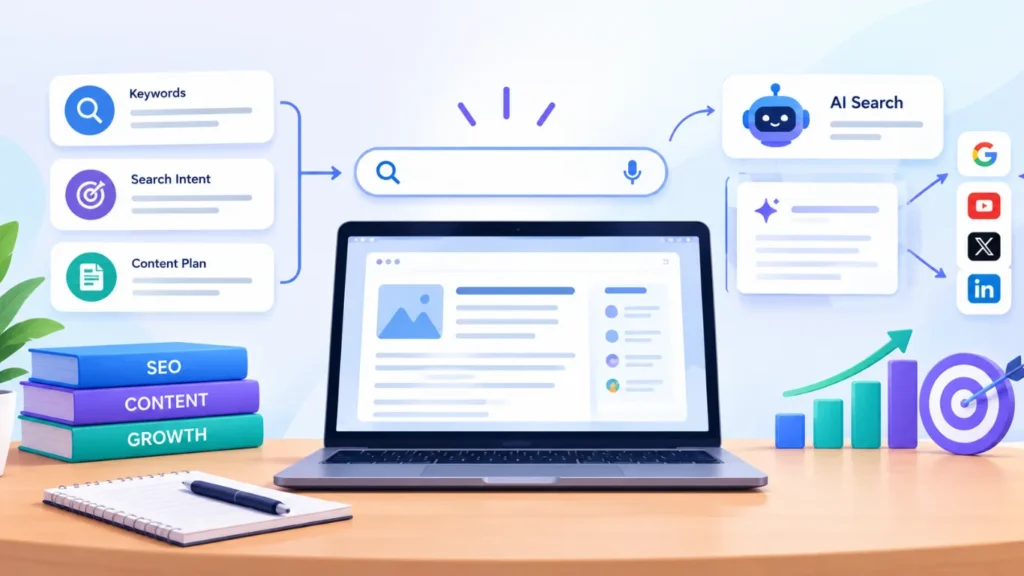
Content marketing is changing. People still use search engines to find answers, compare services, and make buying decisions, but their search journeys increasingly include AI-powered search experiences, social media platforms, online communities, and video content. For businesses, this means publishing blog posts regularly is no longer enough. Content must be useful wherever potential customers look for information.
A search-first content strategy for 2027 starts with understanding what your audience wants to know, how they search for answers, and what information will help them make a decision. Instead of creating content based only on trending topics or a list of keywords, businesses build their content around real customer needs, search intent, and measurable business goals.
This approach combines traditional SEO with helpful website content, social discovery, AI search visibility, and conversion-focused planning. It also gives every article, landing page, video, and resource a clear purpose.
In this guide, we will explain how to develop a search-first content strategy, identify the right topics, create content that stands out, and measure results in 2027.
What Is a Search-First Content Strategy?
A search-first content strategy is a method of planning and creating content around the questions, problems, needs, and decisions of your target audience. It considers how people discover information across search engines, AI-powered search tools, social platforms, and other relevant channels.
The goal is not simply to rank for keywords. It is to provide the right information at the right stage of the customer journey, build trust, attract relevant visitors, and encourage meaningful actions.
For example, a business selling website development services might create:
- An educational guide explaining how website development works.
- A comparison article about custom websites and website builders.
- A service page targeting businesses looking for website development.
- A case study showing how a website redesign improved lead quality.
- Short social media videos answering common website questions.
Each asset supports a different search need while contributing to the same business objective.
Google’s guidance on helpful content emphasizes creating reliable, people-first information that provides genuine value rather than content made primarily to manipulate rankings. This is a useful foundation for a search-first strategy.
Why Search-First Content Matters in 2027
Search-first content helps businesses connect their content production with actual customer demand. It also reduces the risk of publishing articles that receive little attention or attract visitors who are unlikely to become customers.
Several developments make this approach particularly useful.
1. Search Is Happening Across More Platforms
Customers may discover a brand through Google, an AI-generated answer, YouTube, Instagram, Reddit, or a recommendation from an online community. The platforms vary by audience and industry, but the underlying need remains the same: people want useful information they can trust.
Businesses should identify the channels their audiences actually use instead of trying to publish everywhere. A B2B company may prioritize Google, LinkedIn, and industry publications, while a visual consumer brand may benefit more from search-friendly product pages, short videos, and social discovery.
2. AI Search Makes Originality More Valuable
AI-powered search experiences can summarize information and help users explore complex questions. As a result, businesses should avoid publishing another generic article that repeats information already available across dozens of websites.
Original examples, expert explanations, practical comparisons, first-hand experience, and useful research give readers a stronger reason to engage with a page.
There is no guaranteed formula for appearing in AI-generated answers. However, Google’s guidance for generative AI search continues to emphasize helpful, distinctive content and sound SEO fundamentals.
3. Content Must Support Business Outcomes
High traffic is useful only when it supports a meaningful objective. A search-first strategy considers whether content helps readers understand a problem, evaluate a solution, contact a business, request a quote, or make a purchase.
For example, a detailed service page attracting 300 highly relevant visitors may generate more qualified enquiries than a general article attracting thousands of unrelated visits.
4. Search Intent Matters More Than Publishing Volume
Publishing more content does not automatically improve organic visibility. If several pages target nearly identical topics, they may compete for similar searches and make it harder for readers to find the most useful resource.
A focused content plan prioritizes quality, topic coverage, and clear page purpose over producing a large number of articles.
Step 1: Define Your Audience and Business Goals
Before researching keywords, decide who you want to reach and what you want your content to achieve.
Start by answering three questions:
- Who is your ideal customer?
- What problems or questions lead them to search for your products or services?
- What action should they take after finding your content?
A digital marketing agency, for example, might target small business owners who need better online visibility, more qualified leads, or improved website conversions.
Its content goals could include increasing relevant organic traffic, generating service enquiries, building brand credibility, and helping prospects understand the agency’s expertise.
Create simple audience profiles based on real customer questions, sales conversations, support requests, website analytics, and feedback. Avoid relying entirely on assumptions about what customers need.
Once your audience and objectives are clear, every proposed content topic should have a reason to exist.
Step 2: Research Keywords and Customer Questions
Keyword research remains an essential part of search-first content planning. However, it should be used to understand customer demand rather than as a checklist for inserting phrases into articles.
Use tools such as Google Search Console, Google Keyword Planner, and relevant SEO platforms to explore search terms, impressions, clicks, and related questions. Review sales enquiries and customer conversations to identify problems that keyword tools might not fully reveal.
Organize your research into three groups:
Primary keywords: The main search phrase that best describes a page’s topic.
Related keywords: Closely connected phrases and concepts that help cover the subject naturally.
Customer questions: Specific concerns people want answered before taking action.
For a business offering SEO services, the research might include:
- SEO services for small businesses
- How to improve website rankings
- Local SEO vs. traditional SEO
- How long does SEO take?
- How to measure SEO performance
- How to choose an SEO agency
Do not create a separate article for every variation. Some questions belong in one comprehensive guide, while others deserve their own page because they reflect a distinct search need.
The aim is to understand the topic from the customer’s perspective and create the most useful resource for that need.
Step 3: Map Search Intent to the Customer Journey
Search intent describes what a person is trying to accomplish with a query. Understanding it helps you choose the right content format and avoid sending users to pages that do not match their needs.
| Search intent | What the user wants | Suitable content |
|---|---|---|
| Informational | Learn about a topic or solve a problem | Guides, tutorials, FAQs |
| Commercial investigation | Compare available options | Comparisons, reviews, case studies |
| Transactional | Purchase or enquire | Service pages, product pages, pricing pages |
| Navigational | Find a specific brand or page | Brand pages, contact pages, resource hubs |
For instance, someone searching for “what is local SEO” probably needs a clear explanation. Someone searching for “local SEO services for restaurants” may be comparing providers and looking for professional help.
Both searches relate to SEO, but they require different content.
Map important keywords to existing or planned pages. This helps reduce unnecessary overlap and ensures that informational articles support, rather than replace, the pages designed to generate enquiries.
Step 4: Build Topic Clusters Around Your Expertise
A topic cluster is a group of related content organized around a central subject. It helps businesses cover a topic in depth and gives readers logical paths to explore related information.
Imagine that your business provides digital marketing services. A search-focused topic cluster might look like this:
- Pillar page: Complete guide to digital marketing strategy.
- SEO articles: Keyword research, technical SEO, local SEO, and content optimization.
- Paid advertising articles: Google Ads budgeting, campaign optimization, and landing pages.
- Conversion articles: Lead generation, landing page design, and website forms.
- Measurement articles: Marketing KPIs, conversion tracking, and performance reporting.
The pillar page introduces the broader subject, while supporting articles answer specific questions in more detail. Internal links connect the resources where they genuinely help readers.
This structure can also help you identify content gaps. If you have several introductory articles but no detailed guide to measuring results, you may need to strengthen that part of your coverage.
Build topic clusters around subjects your business can credibly explain. Do not expand into unrelated topics simply because they appear to have search demand.
Step 5: Create Content That Offers Something Different
Once you understand the audience, keywords, and intent, focus on the value your content can provide.
A useful article should answer the main question clearly and help the reader move forward. It should not require visitors to read several other pages just to find basic information.
To make your content more valuable:
- Add practical examples: Explain how a strategy works in a realistic business situation.
- Use expert insights: Include relevant observations from people who understand the subject.
- Provide actionable steps: Give readers a process they can follow.
- Explain trade-offs: Discuss limitations, costs, risks, and situations where an approach may not work.
- Use original evidence: Include genuine case studies, research, screenshots, or results when available and appropriate.
- Answer follow-up questions: Anticipate what readers are likely to ask next.
For example, an article about improving website conversions should do more than recommend better headlines. It can explain how to identify form abandonment, test different calls to action, review mobile usability, and measure completed enquiries.
This is also where human expertise matters. AI tools can assist with research, outlines, and editing, but the final content should be reviewed for accuracy, relevance, originality, and real-world usefulness.
Step 6: Optimize for Traditional SEO and AI Search
A search-first strategy should support discoverability without relying on unverified AI search tricks.
Start with established SEO practices:
Use Clear Titles and Headings
Write a descriptive page title and a clear main heading. Organize the content with logical H2 and H3 headings so readers can scan it easily.
Answer the Main Question Early
Give a direct, concise answer near the beginning of the relevant section. Then provide examples, context, and deeper explanation.
For example:
What is a search-first content strategy?
A search-first content strategy plans content around audience needs, search intent, and business goals. It helps businesses create useful resources that can be discovered through search engines and other relevant channels while guiding readers toward informed decisions.
This format is easy to understand and useful for readers who want a quick answer before exploring the full topic.
Use Natural Language and Related Concepts
Include the primary keyword where it fits naturally, along with relevant terms and related questions. Avoid repeating the same phrase in every heading.
Strengthen Trust and Expertise
Provide accurate information, cite reliable sources when needed, identify authors appropriately, and keep important pages up to date. Use first-hand experience and original evidence where available.
Maintain Technical Accessibility
Make sure important pages can be crawled and indexed. Review internal links, mobile usability, page performance, canonical URLs, and other technical SEO fundamentals.
Do not assume that special formatting, artificial keyword repetition, or a separate AI-only content file will guarantee visibility in generative search. Focus on content quality and technical accessibility first.
Step 7: Connect Content With Internal Links
Internal linking helps readers move between relevant pages and helps search engines understand how resources relate to one another.
Every important article should link to related resources where the connection is useful. For example, an article about keyword research could link to a broader SEO guide, while a discussion of conversion-focused content could point readers toward a relevant lead generation service.
For a website such as ASINFOVISION, potential internal links include:
- SEO services: Link from articles about organic visibility, keyword research, and technical optimization.
- Website designing and web development: Link from content about website usability, performance, accessibility, and landing pages.
- Google Ads management: Link from articles about paid search, advertising budgets, and campaign optimization.
- Social media marketing: Link from content about social discovery and cross-channel promotion.
- Lead generation services: Link from guides about conversion optimization, lead qualification, and enquiry forms.
- Graphic designing: Link from articles discussing visual content and brand consistency.
- Digital marketing training: Link from educational resources for teams learning marketing skills.
Use descriptive anchor text that explains what readers will find. Avoid forcing links into unrelated paragraphs, and do not invent URLs. Add the actual destination URLs when publishing the article.
Internal links should create a natural journey from learning about a problem to exploring possible solutions. They are most useful when they support the reader’s next step.
Step 8: Extend Content Beyond the Blog
A search-first strategy does not mean turning every blog post into a social media post. It means adapting useful information to the channels where your audience is likely to discover and consume it.
A detailed article about search intent could become:
- A short video explaining the difference between informational and transactional searches.
- A LinkedIn post showing how search intent influences landing page decisions.
- A visual checklist for planning keywords.
- An email sharing the article’s most useful lessons.
- A presentation for a marketing workshop.
Each format should provide value on its own rather than simply copying the same text everywhere.
Choose distribution channels based on your audience, available resources, and the role of each platform in the customer journey. Track which formats create meaningful engagement, referral visits, and qualified enquiries.
This approach can extend the usefulness of strong content while helping your brand build consistent visibility across relevant channels.
Step 9: Create a Realistic Content Calendar
A content calendar turns your strategy into an actionable publishing plan. It should prioritize important topics, assign responsibilities, and allow time for research, review, promotion, and updates.
For each planned asset, record:
- Topic and primary keyword
- Search intent and target audience
- Content format
- Main business goal
- Internal links to include
- Subject-matter reviewer
- Publication date
- Promotion channels
- Performance measures
- Review or update date
A small business might begin with one strong pillar page and a few supporting articles each month rather than trying to publish every day.
Prioritize topics using factors such as customer relevance, business value, existing content gaps, competitive difficulty, and the resources needed to produce a useful page.
Leave room in the calendar for updating existing content. Improving an article that already attracts relevant impressions may be more valuable than publishing a new page on a similar topic.
Step 10: Measure Results and Improve the Strategy
A search-first content strategy should be reviewed against business goals, not just publishing activity.
Useful measures include:
| Metric | What it helps you understand |
|---|---|
| Organic impressions | How often pages appear in search results |
| Organic clicks | How many visits come from search |
| Relevant search queries | Whether pages attract the intended audience |
| Engagement and navigation | Whether visitors explore useful resources |
| Qualified leads | Whether content attracts potential customers |
| Conversion rate | How often visitors complete a desired action |
| Assisted conversions | Whether content supports decisions before conversion |
Use Google Search Console to review search queries, impressions, clicks, and page performance. Use website analytics and CRM data, where available, to understand whether visitors become leads or customers.
For AI search visibility, monitor available referral traffic, relevant brand mentions, and any reporting tools provided by the platforms you use. Attribution may be incomplete, so avoid treating one metric as a complete picture of performance.
Review results regularly. If a page receives impressions but few clicks, revisit its title, description, and relevance to the query. If it attracts visitors but generates no meaningful action, examine intent alignment, content usefulness, calls to action, and the next steps offered to readers.
Do not change content simply because it has not ranked immediately. Assess the evidence, identify the likely problem, and make improvements that benefit the audience.
Common Search-First Content Mistakes to Avoid
Even a well-planned strategy can lose direction if content decisions are driven by shortcuts.
Publishing for keywords alone: Search volume does not automatically mean a topic is relevant to your business or audience.
Producing generic AI content at scale: Content that repeats existing information without useful review, evidence, or original insight can offer little value.
Ignoring existing pages: Publishing new content while outdated or overlapping pages remain unresolved can waste time and create confusion.
Overlooking conversion paths: Informational content should help readers find relevant next steps without turning every article into a sales pitch.
Chasing every platform: Choose channels based on audience behavior and business priorities instead of spreading resources too thin.
Measuring traffic alone: Relevant enquiries, conversion quality, and the role of content in customer decisions matter alongside visibility.
Avoiding these mistakes keeps your content plan focused on useful information and sustainable business growth.
Frequently Asked Questions
1. What is a search-first content strategy?
A search-first content strategy organizes content around the questions, needs, and search behavior of a target audience. It combines keyword research, search intent, helpful content, technical SEO, and relevant distribution channels to improve discoverability and support business goals.
2. How is search-first content different from traditional SEO content?
Traditional SEO content often focuses on improving visibility for specific search queries. Search-first content takes a broader view by connecting search intent with the customer journey, content formats, user experience, AI search discovery, and conversions. SEO remains a core part of the strategy, but content is planned around audience needs and business outcomes.
3. How can businesses optimize content for AI search in 2027?
Businesses should publish original, accurate, well-structured content that demonstrates relevant expertise and answers real questions. Clear headings, descriptive page titles, accessible technical structure, credible sourcing, and useful examples help readers and search systems understand a page. No technique guarantees that a page will be included in an AI-generated answer.
4. How often should a business publish new content?
There is no ideal publishing frequency for every business. A practical schedule depends on your resources, audience needs, competition, and ability to maintain quality. Publishing fewer, more useful resources and updating important existing pages can be more effective than producing large volumes of repetitive content.
5. Which tools help with search-first content planning?
Google Search Console helps identify queries and page performance, while Google Keyword Planner and SEO research platforms can support keyword discovery. Website analytics can show how visitors behave, and CRM data can help connect content with qualified leads. Customer interviews and sales feedback are also valuable sources of topic ideas.
6. How do you measure the success of a search-first content strategy?
Measure visibility, relevant organic traffic, engagement, qualified leads, conversion rates, and the contribution of content to customer decisions. Use search performance data alongside analytics and CRM information where possible. The right measures depend on whether a page is designed to educate, build trust, support comparisons, or generate enquiries.
Conclusion
A successful search-first content strategy for 2027 begins with people, not publishing volume. Businesses need to understand what their audiences are searching for, match content to search intent, and create resources that offer more than a summary of information already available elsewhere.
Traditional SEO remains essential, but a strong strategy also considers AI-powered search, social discovery, internal linking, technical website quality, and the path from information to conversion. Original insights, credible evidence, clear writing, and practical examples help content become more useful to readers and more distinctive in a crowded search environment.
Start by reviewing your existing pages, identifying important content gaps, and prioritizing topics that connect customer needs with business goals. Measure what happens after people discover your content, then improve the pages that have the greatest potential.
ASINFOVISION, a digital marketing company, helps businesses build and execute integrated digital strategies across SEO, websites, social media, and lead generation. Whatever approach you choose, focus on building visibility, trust, qualified leads, and meaningful conversions rather than chasing vanity metrics.