


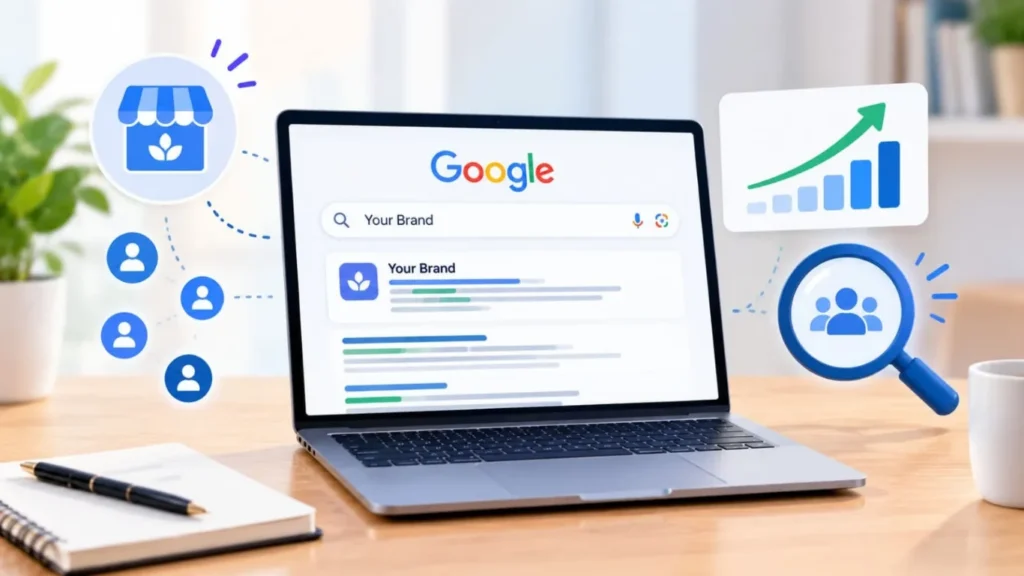
When someone searches for your brand by name, it means they already know you exist.
Maybe they saw your business on social media. Maybe they read one of your blog posts, saw an advertisement, heard about you from a friend, or came across your website while searching for something else.
Whatever the reason, they remembered your name.
That matters.
In digital marketing, brand search demand is a useful sign that people are becoming more familiar with your business. It can show that your marketing is creating awareness and that your brand is starting to stand out in a crowded market.
For example, someone searching for “SEO services” is still looking at their options. But someone searching for “ASINFOVISION SEO services” already has a particular company in mind.
The second person is not just looking for an SEO service. They are looking for a specific brand.
That small difference can tell you a lot about the way people move from discovering a business to considering it.
What Is Brand Search Demand?
Brand search demand is the interest people show by searching for your business or brand name online.
These searches can be simple, such as:
- Your brand name
- Your company name
- Your product name
They can also be more specific:
- Your brand + services
- Your brand + reviews
- Your brand + pricing
- Your brand + location
- Your brand + contact
- Your brand + product
For example, a company might notice searches such as:
“ASINFOVISION”
“ASINFOVISION digital marketing”
“ASINFOVISION SEO services”
These are branded searches because the user has included the business name.
Compare that with searches such as:
“best digital marketing agency”
“SEO services in India”
“website design company”
These are non-branded searches.
The person knows what they need, but they may not know which company they want to choose.
Both types of searches are valuable. They simply represent different stages of the customer journey.
Why Do Brand Searches Matter?
People usually do not search for a company they have never heard of.
That makes branded searches an interesting indicator of awareness.
If very few people search for your brand today but significantly more people search for it six months from now, something has changed.
Perhaps your content is reaching more people.
Maybe your social media presence has improved.
Perhaps your SEO strategy is bringing your website in front of a larger audience.
It could also be the result of advertising, referrals, reviews, events, partnerships, or word of mouth.
Brand searches do not tell you exactly which channel created the awareness, but they can show that people are starting to remember your business.
And being remembered is important.
When someone needs a product or service later, they are more likely to consider brands they already recognize.
Branded Search vs Non-Branded Search
Understanding this difference can make your SEO reporting much more useful.
Non-branded search
A non-branded search usually focuses on a problem, service, product, or question.
For example:
“How to improve Google rankings”
“SEO agency near me”
“best website development company”
The searcher is still exploring.
They may click several results and compare different businesses.
Branded search
A branded search includes a specific business or product name.
For example:
“ASINFOVISION”
“ASINFOVISION reviews”
“ASINFOVISION SEO services”
The searcher has already moved beyond the general discovery stage.
They are interested in a particular business.
This is why a healthy SEO strategy should not focus entirely on non-branded keywords.
Getting discovered is important, but getting remembered is important too.
Brand Searches Can Be a Sign of Growing Awareness
Think about how people normally discover a new business.
They might see an Instagram post today.
They may not need the service immediately, so they keep scrolling.
A few weeks later, they have a problem that the business can solve.
They remember the name and search for it.
That search might look like a simple Google query for the brand.
From the outside, it can look like a normal organic search.
But there is a bigger story behind it.
The original social media post created awareness. The branded search happened later when the person had a stronger reason to investigate the business.
This is why customer journeys are rarely as simple as:
Search → Click → Buy
There are often several interactions in between.
Brand Demand Is Bigger Than SEO
Brand search demand is closely connected to SEO, but it is not created by SEO alone.
People can discover a business in many different places.
For example:
- Google search
- Social media
- YouTube
- Online reviews
- Paid advertising
- Blog articles
- Email newsletters
- Recommendations
- Industry events
- Podcasts
- Online communities
- AI-powered search
A person might discover your company through one channel and search for you through another.
That is completely normal.
For this reason, brand search can be useful when evaluating your overall marketing strategy.
It can show that different channels are helping people become familiar with your business.
How Content Marketing Can Create Brand Demand
Good content does more than attract search traffic.
It can also introduce your brand to people who may become customers later.
Imagine someone searches:
“How can a small business improve its SEO?”
They find your article.
The article is useful, easy to understand, and answers the questions they had.
They may not contact you that day.
But they remember your company.
Later, when they need professional help, they may search for your brand instead of starting their research all over again.
This is one reason [content marketing] can have value beyond immediate traffic.
Your content can become the first introduction between your business and a potential customer.
The important thing is to make that first interaction worthwhile.
Avoid creating articles simply because a keyword has search volume.
Answer real questions.
Give practical advice.
Use examples.
Explain complicated ideas clearly.
Make the reader feel that they learned something useful.
That is how content can help build familiarity over time.
Social Media Can Also Lead to Brand Searches
Social media is another important part of brand awareness.
A person may discover your business through a LinkedIn post, Instagram Reel, Facebook post, YouTube video, or another platform.
They may not click through immediately.
Instead, they might remember the brand and search for it later.
This is especially likely when the content is useful rather than overly promotional.
For example, a digital marketing company could publish a short post explaining three common SEO mistakes.
Someone finds the advice useful.
They remember the company name.
Later, they need SEO help and search for that company.
That is a successful marketing interaction even though the original social media post did not generate an immediate lead.
This is one reason [social media marketing] should not always be judged only by direct conversions.
Some social content is designed to create awareness first.
Brand Search Can Influence Trust
People are usually more comfortable researching a business they recognize.
Imagine that you are looking for a service and see the same company several times.
You notice its social media posts.
Then you find one of its articles.
Later, you see the company in a search result.
Eventually, you may search the business by name.
By this point, the company does not feel completely unfamiliar.
That familiarity can make the research process easier.
Of course, recognition does not automatically create trust.
The business still needs to provide good information, genuine reviews, a professional website, clear services, and a good customer experience.
But brand familiarity can make it easier for people to move from awareness to consideration.
Your Website Needs to Support Branded Searches
Getting someone to search for your brand is only part of the job.
What happens when they arrive?
Your website should make it easy for visitors to understand your business.
Your homepage should quickly explain what you do.
Your service pages should provide useful information about your offers.
Your contact details should be easy to find.
Your content should answer common questions.
Your website should also make it simple for visitors to move between related pages.
For example, someone reading an article about SEO should be able to find your SEO service page without having to return to the main menu and search for it.
This is where internal linking becomes useful.
Use Internal Links to Guide Interested Visitors
Internal links connect pages on the same website.
They are useful for SEO, but they are also useful for people.
Suppose someone is reading an article about improving local visibility.
They may want to learn more about local SEO services.
A natural link to your local SEO services page gives them an obvious next step.
Someone reading about website performance may be interested in website design and development services.
A reader researching lead generation may want to explore your lead generation services.
The link should make sense in the context of the article.
Avoid adding links just to increase the number of internal links.
Also avoid vague anchor text such as:
“Click here.”
Instead, use descriptive phrases such as:
“learn more about our SEO services”
or:
“explore our website design and development services.”
This helps readers understand what they will find before they click.
Brand Searches Can Support the Customer Journey
A branded search often happens somewhere in the middle of the buying journey.
Consider this example:
A person sees your social media post.
↓
They remember your brand.
↓
They later search your company name.
↓
They visit your website.
↓
They read your service pages and reviews.
↓
They compare your business with competitors.
↓
They contact you.
The branded search was not necessarily the final conversion.
But it was part of the journey.
This is why marketers should be careful when looking at last-click data.
A customer may have interacted with your business several times before becoming a lead.
Understanding these interactions is an important part of [digital marketing analytics].
How to Measure Brand Search Demand
If you want to know whether people are searching for your brand more often, start by looking at your search data.
Google Search Console can help you identify queries that bring people to your website.
Look for searches containing:
- Your brand name
- Common brand variations
- Brand + service
- Brand + location
- Brand + product
- Brand + reviews
Then compare the data over time.
You can also look at website analytics to understand what happens after people arrive.
For example:
- Do they visit important service pages?
- Do they contact your business?
- Do they return later?
- Do they spend time reading your content?
- Do they complete a form?
- Do they make a purchase?
The goal is not simply to increase branded searches.
The goal is to turn growing awareness into meaningful business results.
More Brand Searches Do Not Automatically Mean More Sales
This is an important distinction.
A rise in brand searches is generally a positive signal, but it should not be treated as proof that revenue will automatically increase.
People search for many different reasons.
Someone might search your brand because they want your phone number.
Another person might be looking for reviews.
Someone else might be comparing you with a competitor.
Another person may simply be curious.
The intent behind the search matters.
That is why brand search demand should be viewed alongside other metrics.
For example:
Brand searches + qualified traffic + leads + conversions
tell you much more than brand searches alone.
The same principle applies to SEO generally.
Traffic is not the same as leads.
Leads are not the same as customers.
Good marketing focuses on the quality of the outcome, not just the size of the number.
How to Increase Brand Search Demand
There is no shortcut that guarantees people will suddenly start searching for your brand.
Brand demand usually grows through consistent marketing.
Create useful content
Answer questions your customers actually have.
Helpful content can introduce your business to people before they are ready to buy.
Build a consistent social presence
Share useful ideas, insights, examples, and information related to your industry.
People are more likely to remember a brand that regularly provides value.
Improve your SEO visibility
A strong [SEO strategy] can help new audiences discover your business through non-branded searches.
Some of those people may later return through branded searches.
Build a recognizable identity
Your website, social profiles, graphics, and content should feel connected.
Consistency makes your business easier to recognize.
Encourage genuine reviews
Positive customer experiences can make people more comfortable researching your brand.
Focus on genuine feedback rather than simply trying to collect as many reviews as possible.
Use paid advertising strategically
Advertising can put your business in front of audiences who may not know you yet.
Even if they do not convert immediately, the exposure can contribute to future brand recognition.
Demonstrate expertise
Share practical knowledge.
Publish detailed guides.
Answer common questions.
Show examples of your work.
The more useful your expertise is, the easier it can be for people to remember your brand.
What If Your Brand Searches Are Low?
Do not panic if your branded search volume is small.
This is common for newer or smaller businesses.
Brand awareness takes time.
Instead of focusing on one number, look at the bigger picture.
Ask yourself:
- Are more people discovering the website?
- Is organic traffic improving?
- Are people engaging with your content?
- Are social interactions increasing?
- Are more visitors returning?
- Are qualified leads increasing?
- Are customers mentioning your business?
- Are referral visits growing?
If several of these signals are improving, your brand may be gaining awareness even if branded search volume is still relatively small.
The important thing is to track the trend over time.
Why Brand Demand Matters in Modern Search
The way people discover businesses is changing.
Search engines are still important, but they are no longer the only place where discovery happens.
People can find brands through social media, videos, reviews, maps, communities, AI-powered search, recommendations, and other channels.
This makes brand recognition increasingly valuable.
If people remember your business, they do not always need to discover you from scratch every time they have a problem.
They can simply search your name.
That can make the customer journey shorter.
It can also reduce your dependence on constantly competing for every generic keyword.
This does not mean businesses should stop targeting non-branded keywords.
They should do both.
Non-branded SEO helps people discover you.
Brand building helps people remember you.
You need both for long-term growth.
Brand Search Demand and SEO Strategy
A strong SEO strategy should not be limited to rankings.
Rankings tell you where your pages appear.
Traffic tells you how many people visit.
But brand search demand can tell you something different:
Are people starting to look for your business specifically?
That is a valuable question.
For example, imagine your SEO campaign increases visibility for several non-branded keywords.
More people discover your website.
Some of them read your content and follow your social accounts.
Others return later.
Over time, more people begin searching for your brand.
That is a sign that your marketing may be moving beyond simple visibility and creating recognition.
This is where SEO and brand marketing start working together.
Think Beyond Keywords
Keywords are still important.
They help businesses understand what people are searching for and create content that matches those needs.
But a successful business needs more than keyword rankings.
You want people to remember your company.
You want them to trust your expertise.
You want them to return when they need help.
You want them to recommend you to others.
That is what makes brand demand so valuable.
Instead of asking only:
“What keyword should we rank for next?”
also ask:
“What can we do to become the brand people remember in this market?”
That question can change the way you approach content, SEO, social media, advertising, and customer experience.
Conclusion
Brand search demand is a simple idea, but it can reveal something important about your marketing.
When people search for your business by name, they are showing that your brand has made an impression.
Maybe they discovered you through Google. Maybe they saw your social media content. Maybe a customer recommended you. Maybe your blog answered a question they had.
Whatever the starting point, the result is the same: they remembered your name.
That is valuable.
Businesses should continue working on traditional SEO and non-branded search visibility because these activities help new customers discover them. At the same time, they should invest in useful content, social media, customer experiences, and consistent branding that make the business easier to remember.
And when you measure the results, do not look at branded searches in isolation.
Connect them with traffic quality, leads, conversions, and revenue.
The ultimate goal is not simply to make more people search your brand.
It is to become the brand they think of when they are ready to solve a problem, choose a service, or make a purchase.
Frequently Asked Questions
What is brand search demand?
Brand search demand refers to the number of people searching for your business, brand name, products, or services by using terms connected directly to your brand. For example, searches such as “Nike shoes,” “Nike running shoes,” or “Nike store near me” show branded search behavior. Growing brand search demand can indicate that more people are becoming aware of your business and actively looking for it.
Why is brand search demand important for SEO?
Brand search demand can be a useful signal of growing brand awareness and interest. When people already know your brand, they may search for it directly instead of discovering your business through generic keywords. This can bring more qualified visitors to your website and support your wider SEO strategy. It also shows that your marketing efforts are helping people remember your business.
What is the difference between branded and non-branded searches?
Branded searches include your company or brand name, while non-branded searches use general terms related to your products or services. For example, “ASICS running shoes” is a branded search, while “best running shoes” is a non-branded search. Both types are valuable, but they represent different stages of the customer journey and require different SEO approaches.
How can businesses increase brand search demand?
Businesses can increase brand search demand by consistently creating useful content, building a recognizable online presence, using social media, investing in digital PR, running advertising campaigns, and providing a strong customer experience. The goal is not simply to make people search for your name. It is to give them a reason to remember your brand and look for it again.
Can social media increase branded searches?
Yes. Social media can introduce your brand to new audiences and encourage people to search for your business later. Someone may see a product, video, customer review, or useful post on social media and then search for the brand independently. This is one reason social media marketing and SEO should not always be treated as completely separate channels.
How can I measure brand search demand?
You can monitor branded search queries and changes in search interest over time using SEO and analytics platforms. Look at trends in branded impressions, clicks, search volume, organic traffic, and the queries people use to find your business. Comparing these numbers over several months can give you a clearer picture of whether brand awareness and search demand are growing.
Does higher brand search demand always mean more sales?
Not necessarily. More people searching for your brand is generally a positive sign, but searches do not automatically become customers. Your website experience, pricing, products, content, reputation, and conversion process all influence what happens after someone searches for your business. Brand search demand should therefore be viewed as one part of the overall customer journey rather than a standalone sales metric.
Should small businesses focus on brand search demand?
Yes. Small businesses can benefit significantly from building branded search demand because it helps create recognition and repeat interest. Instead of relying only on generic searches where competition can be high, a growing number of people may eventually search directly for the business. Consistent content, strong customer experiences, local visibility, and social media activity can all help build that recognition over time.