


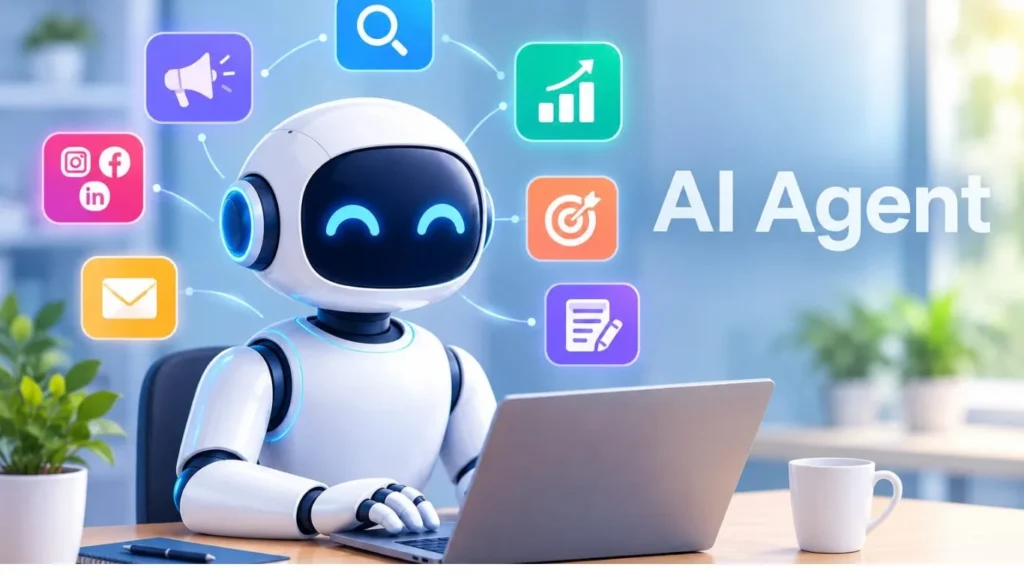
Businesses are no longer using AI only to write blog posts, create ad copy, or analyze reports. A new generation of AI tools is beginning to take a more active role in marketing: AI agents.
An AI agent can understand a request, work with information, make decisions, and complete certain tasks with limited human intervention. In digital marketing, this can mean answering customer questions, qualifying leads, personalizing interactions, supporting campaigns, analyzing customer behavior, and helping people move through the buying journey.
For businesses, the opportunity is significant. But so are the questions.
What exactly is an AI agent? How is it different from a traditional chatbot? Where can businesses use AI agents in marketing? And how can companies adopt this technology without making customer experiences feel robotic?
As businesses prepare for the changing digital marketing landscape in 2027, understanding AI agents can help marketing teams make better technology decisions.
What Is an AI Agent in Digital Marketing?
An AI agent in digital marketing is an AI-powered system designed to understand objectives, process information, make decisions, and take actions related to marketing or customer interactions.
Traditional automation usually follows fixed instructions.
For example:
If a visitor fills out a form → send a confirmation email.
An AI agent can work with more context.
For example, a visitor might ask a question about SEO services. The AI agent can understand the question, identify what the visitor is trying to achieve, provide relevant information, ask follow-up questions, and potentially direct the visitor toward a consultation or suitable service.
AI agents can support tasks such as:
- Customer conversations
- Lead qualification
- Personalized recommendations
- Marketing automation
- Customer segmentation
- Campaign support
- Data analysis
- Content discovery
- Appointment scheduling
- Customer support
- Follow-up communication
This makes AI agents different from simple rule-based automation.
However, businesses should not view AI agents as replacements for marketing teams. The role of AI should be to improve efficiency and customer experiences while allowing people to focus on strategy, creativity, expertise, and complex decisions.
Why Are AI Agents Becoming Important for Businesses?
Customer expectations are changing.
People want fast answers, relevant recommendations, and easy access to information. At the same time, businesses are dealing with large volumes of enquiries, content, data, and marketing activities.
AI agents can help connect these two needs.
Instead of making customers:
Search → browse → compare → fill out a form → wait for a response
businesses can create experiences where AI helps customers:
Ask → understand → explore → decide → take action
This can be particularly useful for businesses with:
- Large numbers of website visitors
- Frequently asked customer questions
- Multiple products or services
- Complex buying journeys
- High enquiry volumes
- Online sales processes
- Lead generation requirements
- Customer support requirements
The important point is that AI agents should solve real customer problems.
Using an AI agent simply because AI is popular is unlikely to create meaningful value.
AI Agents vs Traditional Chatbots: What Is the Difference?
AI agents and chatbots are related, but they are not necessarily the same.
A traditional chatbot may rely on predefined questions and answers.
For example:
Customer: “What are your opening hours?”
Chatbot: “We are open from 9 AM to 6 PM.”
An AI agent may be able to understand a more complicated request and determine what information or action is needed.
For example:
Customer: “I run a local business and want more enquiries from Google. Which service would be right for me?”
An AI agent could understand that the customer is asking about local SEO and lead generation, provide relevant information, ask about the business location and goals, and recommend an appropriate next step.
The exact capabilities depend on how the AI agent is designed and what systems or information it can access.
The key difference is context and action.
A chatbot may primarily provide answers. An AI agent can potentially interpret a goal and complete multiple steps toward that goal.
1. AI Agents Can Improve Customer Experiences
One of the strongest business applications for AI agents is customer experience.
A customer may visit a website with a specific question but not know exactly where to find the answer.
An AI agent can help them navigate the information.
For example, an online visitor could ask:
- Which service is right for my business?
- How does your SEO service work?
- What is included in a digital marketing package?
- Can I book a consultation?
- Which product should I choose?
- How long does implementation usually take?
Instead of forcing the visitor to search through multiple pages, an AI agent can provide a more conversational experience.
This does not mean the website becomes less important.
The website still needs strong service pages, clear navigation, useful content, trust signals, fast loading times, and clear calls to action. AI should make the website easier to use rather than compensate for poor website structure.
Businesses looking to improve this foundation can also explore professional website designing and web development as part of their wider digital strategy.
2. AI Agents Can Personalize Marketing
Personalization is another major opportunity.
Customers do not all have the same needs. A startup looking for its first SEO strategy may require very different information from an established e-commerce business trying to improve organic traffic.
An AI agent can use conversation context to make interactions more relevant.
For example, it could identify whether someone is:
- Researching a solution
- Comparing providers
- Ready to buy
- Looking for technical information
- Existing customer
- Looking for support
This can help businesses deliver information based on where the customer is in the journey.
Businesses should use customer information responsibly and ensure that personalization supports the customer rather than becoming intrusive.
3. AI Agents Can Help Generate and Qualify Leads
Getting website traffic is not enough.
Businesses need visitors to take meaningful actions.
AI agents can support lead generation by engaging visitors and helping determine whether they are potential customers.
For example, an AI agent for a digital marketing company might ask:
- What type of business do you operate?
- What marketing challenge are you facing?
- Are you currently investing in SEO or paid advertising?
- What is your main goal?
- Would you like to speak with a marketing specialist?
The answers can help determine what should happen next.
A qualified lead might be directed to a consultation. Someone who is still researching could receive an educational guide or relevant service information.
This creates a more useful customer journey because the visitor receives information based on their needs instead of being immediately pushed toward a sales form.
Businesses can combine AI agents with broader lead generation strategies to create a more connected path from website discovery to conversion.
4. AI Agents Can Support Marketing Automation
Marketing automation already helps businesses manage repetitive tasks.
AI agents can add another layer of flexibility.
Instead of sending exactly the same message to every person who performs an action, AI can potentially help determine what information is most relevant based on context.
For example, two people might download the same guide.
One may be interested in SEO.
The other may be interested in Google Ads.
Their next interactions do not necessarily need to be identical.
AI agents can help marketing teams create more responsive workflows by interpreting customer actions and available information.
Potential applications include:
- Follow-up communication
- Lead nurturing
- Customer segmentation
- Content recommendations
- Campaign support
- Customer engagement
- Marketing data analysis
Still, businesses need clear rules and human oversight.
AI should support a marketing strategy rather than make uncontrolled decisions.
5. AI Agents Can Work With AI Search and Conversational Search
AI is also changing how customers discover information.
People increasingly have access to search experiences that provide direct answers instead of requiring them to visit multiple websites.
This makes AI search optimization increasingly relevant to businesses.
The goal is no longer only to appear for a traditional keyword.
Businesses also need to think about whether their brand, expertise, services, and information can be clearly understood across modern search and AI-powered discovery experiences.
The brief describes this shift as moving from:
Search visibility → AI visibility → Brand visibility
It also highlights AI-generated answers, conversational search, AI Overviews, AI citations, and zero-click search as important areas for businesses to understand.
This does not mean businesses should abandon traditional SEO.
Instead, SEO, content quality, structured information, brand authority, and AI search visibility should work together.
6. AEO and GEO Can Support AI Visibility
Businesses are also hearing more about Answer Engine Optimization (AEO) and Generative Engine Optimization (GEO).
AEO focuses on creating content that clearly answers questions.
GEO focuses on helping generative AI systems understand, reference, or surface useful information about a business.
These approaches should not be treated as replacements for SEO.
They are additional layers of search visibility.
Businesses can prepare by creating:
- Clear answers to customer questions
- Detailed FAQs
- Expert content
- Well-structured service pages
- Consistent business information
- Helpful educational resources
- Strong topical authority
- Structured data
- Trustworthy brand information
- Original insights and case studies
This approach also benefits customers because clear, well-organized information is easier for people to understand.
7. AI Agents Can Make Customer Support More Efficient
Customer support is another practical application.
Many businesses receive repetitive questions every day.
Customers may ask about:
- Product features
- Service details
- Delivery information
- Booking procedures
- Account processes
- Basic troubleshooting
- Documentation
- Policies
An AI agent can handle suitable routine questions and provide immediate assistance.
But businesses should establish clear escalation rules.
If a customer has a complicated problem, complaint, or situation requiring human judgment, the AI agent should make it easy to connect with a person.
A good customer experience is not about eliminating human support.
It is about making sure customers reach the right type of support at the right time.
8. AI Agents Can Support Better Customer Journey Management
The customer journey is becoming less linear.
A person might:
- Discover a business through Google.
- See the company on social media.
- Read a blog post.
- Visit a service page.
- Ask an AI agent a question.
- Leave the website.
- Return several days later.
- Request a consultation.
AI agents can become one part of this connected journey.
This is why businesses should not think about AI agents as isolated website features.
They should consider how the technology fits into the wider marketing ecosystem:
SEO + Content + Website + Social Media + Paid Advertising + CRM + Lead Generation + Customer Support
9. AI Agents Need High-Quality Content
There is a simple principle businesses should remember:
Better information creates better AI experiences.
If your website contains outdated information, unclear service descriptions, inconsistent messaging, or weak FAQs, an AI agent has less reliable information to work with.
Before implementing an AI agent, businesses should review their content.
Useful resources may include:
- Service pages
- Product descriptions
- FAQs
- Knowledge bases
- Case studies
- How-to guides
- Pricing information
- Support documentation
- Customer questions
- Industry insights
This also supports broader content marketing goals.
AI can help create content faster, but expertise gives that content value.
10. Human Expertise Still Matters
AI agents are powerful, but they should not operate without boundaries.
Customers still value human expertise when situations become complicated.
Human involvement is especially important for:
- Complex purchases
- Strategic consulting
- Complaints
- Sensitive situations
- High-value customers
- Technical problems
- Negotiation
- Creative decisions
- Industry-specific advice
The best model is often:
AI for speed + humans for judgment
AI can answer routine questions and process information. People can handle empathy, strategy, creativity, and complex decisions.
This balance is especially important as businesses expand their use of AI-powered marketing.
What Businesses Should Consider Before Using AI Agents
Before investing in an AI agent, ask a few practical questions.
1. What customer problem are we solving?
Do not begin with the technology.
Begin with the customer.
Identify where customers currently experience friction.
2. Which tasks are repetitive?
Look for questions and processes that happen frequently and have predictable outcomes.
3. Is our information accurate?
An AI agent needs reliable information.
Review your website, FAQs, service pages, product information, and internal knowledge before implementation.
4. When should a human take over?
Create clear escalation points.
Customers should not become trapped in an automated loop.
5. How will we measure success?
Possible metrics include:
- Qualified leads
- Conversion rate
- Customer satisfaction
- Response time
- Appointment bookings
- Support resolution
- Cost per lead
- Customer retention
Common AI Agent Mistakes Businesses Should Avoid
Automating Everything
Not every customer interaction needs AI.
Some conversations are better handled by people.
Giving Generic Answers
If the AI agent simply repeats information already visible on the website, customers may not find it useful.
Ignoring Content Quality
An AI agent cannot fix poor information architecture or outdated business content.
Measuring Conversations Instead of Results
A high number of conversations does not automatically mean better marketing.
Focus on qualified leads, conversions, customer satisfaction, and other meaningful outcomes.
Removing Human Support
Customers should always have an appropriate route to human assistance.
Using AI Without a Clear Strategy
Technology should support a defined marketing objective.
It should not become another disconnected tool in the marketing stack.
How to Start Using AI Agents in Digital Marketing
Businesses do not need to implement an advanced AI system immediately.
A practical approach is to start small.
Step 1: Identify a Customer Pain Point
Review website enquiries, support conversations, sales questions, and customer feedback.
Find recurring problems.
Step 2: Choose One Use Case
Start with something measurable, such as:
- Lead qualification
- FAQ assistance
- Service discovery
- Appointment booking
- Product recommendations
Step 3: Improve Your Website and Content
Make sure the information an AI agent needs is accurate, useful, and easy to understand.
Step 4: Define Human Handoffs
Decide which situations require a person.
Step 5: Measure Performance
Track whether the AI agent improves customer outcomes.
Step 6: Improve Over Time
Use customer questions and feedback to identify gaps in the experience.
This approach reduces unnecessary complexity and allows businesses to learn what actually works.
AI Agent in Digital Marketing: Key Benefits
| AI Agent Application | Business Benefit |
|---|---|
| Customer support | Faster answers to routine questions |
| Lead qualification | Better identification of potential customers |
| Personalization | More relevant customer interactions |
| Recommendations | Easier product or service discovery |
| Marketing automation | Less repetitive manual work |
| Conversational experiences | Easier information discovery |
| Customer journey support | Smoother movement toward conversion |
| Data analysis | Better marketing decisions |
| Human escalation | Better handling of complex situations |
Frequently Asked Questions
What is an AI agent in digital marketing?
An AI agent in digital marketing is an AI-powered system that can understand customer requests, process information, make decisions, and perform marketing-related actions. Businesses can use AI agents for customer support, lead qualification, personalization, recommendations, marketing automation, appointment scheduling, and other customer journey activities.
How can AI agents help businesses?
AI agents can help businesses automate repetitive tasks, provide faster customer assistance, personalize interactions, qualify leads, and improve information discovery. They can also support marketing teams by analyzing information and helping customers move through different stages of the buying journey. Their effectiveness depends on good data, useful content, clear workflows, and appropriate human oversight.
Are AI agents the same as chatbots?
Not always. Traditional chatbots often rely on predefined rules and responses. AI agents can potentially understand more complex requests, use context, make decisions, and perform multiple actions. However, capabilities vary depending on how an AI agent is built and what information or systems it can access.
Will AI agents replace digital marketers?
AI agents are more likely to support digital marketers than completely replace them. They can handle repetitive tasks and assist with data, customer interactions, and automation. Human marketers remain important for strategy, creativity, brand positioning, expertise, and complex decision-making. Businesses should view AI as a productivity and customer-experience tool.
How do AI agents affect SEO?
AI agents do not replace SEO. However, they make helpful, structured, authoritative content increasingly valuable because customers may interact with information through conversational search and AI-powered experiences. Businesses should continue investing in technical SEO, search intent, topical authority, helpful content, internal linking, structured data, and brand authority.
Should small businesses use AI agents?
Small businesses can use AI agents when they have a clear problem that automation can solve. They do not need to build a complicated system immediately. Starting with a focused use case such as answering common questions, qualifying leads, or helping visitors find the right service can be a practical approach.
Conclusion
The AI agent in digital marketing is becoming an important development for businesses preparing for the future of digital marketing.
AI agents can help businesses respond faster, personalize customer interactions, qualify leads, automate repetitive tasks, support customer service, and connect different stages of the customer journey.
But technology alone does not create a better customer experience.
Businesses still need a strong website, useful content, effective SEO, accurate information, thoughtful marketing strategies, and human expertise. AI agents should work alongside these elements rather than replace them.
The best starting point is simple: identify where customers experience friction and determine whether AI can genuinely make that experience easier.
As AI-powered marketing continues to develop, businesses that combine automation with human judgment, helpful content, and measurable business goals will be better positioned to adapt.
For businesses looking to build a stronger digital presence, an integrated approach that connects SEO, website development, social media, paid advertising, content, and lead generation can provide a more sustainable foundation than relying on one technology alone.
AI agents are another layer of that ecosystem — and their real value will depend on how well they serve both the customer and the business.