
1 view
A business can rank well on Google and still miss opportunities to reach customers who use AI-powered search tools to research products, compare services, and find recommendations. As search experiences evolve, businesses must understand how traditional search engine optimization (SEO) and AI search work together to influence online visibility.
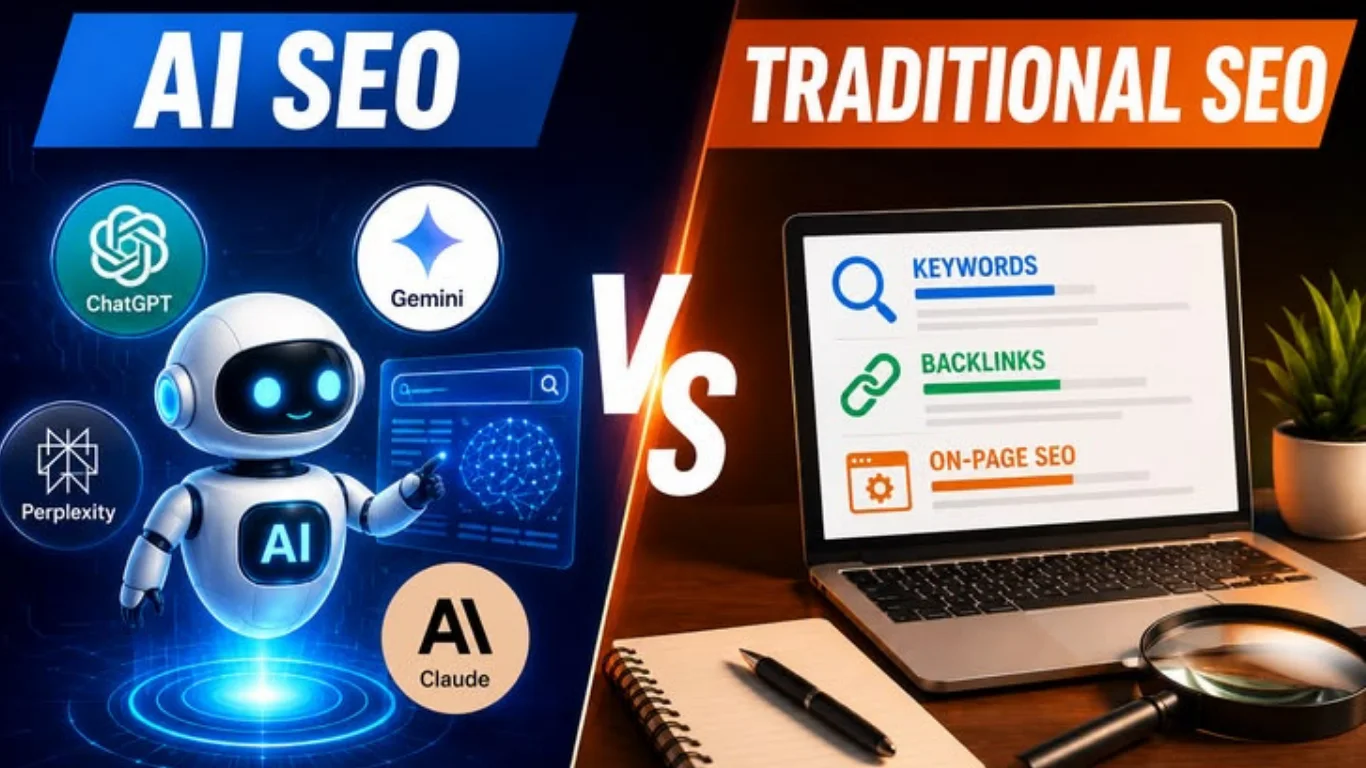
AI search vs. traditional SEO in 2027 is not a choice between two competing strategies. It is about combining established SEO practices with new ways of making a brand visible in AI-generated answers.
Traditional SEO helps websites appear in search engine results through relevant content, technical performance, backlinks, and a strong user experience. AI search, meanwhile, can summarize information, answer conversational questions, and reference sources that help users make decisions.
For business owners, startups, and marketing managers, this shift creates both challenges and opportunities. A strong search strategy must go beyond rankings to include brand authority, helpful content, AI visibility, and qualified lead generation.
In this guide, we will explore the differences between AI search and traditional SEO, explain why both matter in 2027, and share practical steps businesses can take to improve their digital presence.
What Is Traditional SEO?
Traditional SEO is the process of improving a website’s visibility in organic search engine results. It helps search engines understand a website’s content and connect it with users searching for relevant information, products, or services.
For example, a company offering website development services might optimize its website for searches such as “website development company” or “custom website design services.”
The goal is to help relevant pages appear when potential customers search for those services.
Key elements of traditional SEO
Traditional SEO typically includes:
- Keyword research: Understanding what potential customers search for.
- On-page SEO: Optimizing page titles, headings, content, URLs, and internal links.
- Technical SEO: Improving crawlability, indexing, site speed, and mobile usability.
- Content optimization: Creating helpful pages that satisfy search intent.
- Link building: Earning relevant, trustworthy backlinks that support authority.
- User experience: Making websites easy to navigate and use.
- Local SEO: Helping businesses improve visibility in geographically relevant searches.
Traditional SEO is not limited to achieving a high Google ranking. It also helps attract relevant visitors, build trust, and turn organic traffic into enquiries or sales.
Businesses can strengthen these foundations through professional SEO services, particularly when their websites have technical issues, weak content structures, or limited organic visibility.
What Is AI Search?
AI search uses artificial intelligence to interpret questions, gather relevant information, and generate answers in a conversational format. Depending on the platform and query, it may summarize information from multiple sources and provide links or citations to supporting websites.
Examples include Google’s AI-powered search experiences and search features available through ChatGPT and other AI assistants.
Imagine a business owner searching for “How can a small company generate more leads through digital marketing?”
A traditional search engine may present a list of relevant articles, service pages, and guides. An AI search experience may provide a summarized explanation, organize recommendations into steps, and reference selected sources.
The user may then visit one of those sources, ask a follow-up question, or make a decision without exploring many separate websites.
How AI search changes online discovery
AI search can influence how customers discover businesses in several ways:
- Conversational queries: Users can ask detailed questions in natural language.
- Summarized answers: Search experiences may provide useful information without requiring users to open several pages.
- Contextual recommendations: Responses can address specific needs, preferences, or situations.
- Source citations: Some AI search experiences link to websites used to support their answers.
- Brand discovery: Businesses may be mentioned or referenced even when users do not visit their websites immediately.
AI search does not always work the same way across platforms, and inclusion in an AI-generated answer is never guaranteed. However, it creates another important area for businesses to consider when developing their online visibility strategy.
AI Search vs Traditional SEO: Key Differences
Although both approaches help users discover information, they differ in how results are presented and how businesses may gain visibility.
| Factor | Traditional SEO | AI Search |
|---|---|---|
| Main experience | Search results containing links and listings | Conversational answers and summaries, sometimes with citations |
| Content discovery | Relevant pages are retrieved and ranked | Relevant information may be synthesized from multiple sources |
| User behaviour | Users often compare several results | Users may receive an initial answer before choosing whether to explore further |
| Content focus | Search intent, relevance, quality, and usability | Clear answers, context, reliable information, and useful supporting sources |
| Visibility measurement | Rankings, impressions, clicks, and organic traffic | Traditional search metrics plus available AI referral and brand-mention data |
| Business opportunity | Attract qualified organic visitors | Improve the chances of being discovered, referenced, or cited in AI responses |
| Conversion path | Search result to website to enquiry or purchase | AI answer to website, another interaction, or a later conversion |
The important distinction is that traditional SEO focuses on organic search visibility, while AI search adds new ways for information and brands to appear in generated answers.
These approaches overlap considerably. AI-powered search systems may use search indexes, retrieved documents, and other sources to produce responses. As a result, sound SEO practices remain valuable.
1. Search Rankings Are Important, but Visibility Is Broader
For years, many businesses have evaluated SEO performance by tracking keyword positions. Rankings remain useful because they indicate how pages perform for specific queries.
However, a high ranking does not automatically guarantee that a business will be selected as a source in an AI-generated answer.
AI search systems may consider the relevance and usefulness of information, the context of the question, and the sources available to them. Their selection processes vary, so no single optimization technique guarantees inclusion.
How businesses should adapt
Instead of focusing exclusively on ranking improvements, businesses should develop a broader visibility strategy.
This includes:
- Maintaining strong organic search rankings.
- Creating content that answers real customer questions.
- Building a recognizable and trustworthy brand.
- Publishing detailed information about products and services.
- Earning relevant mentions and links from credible websites.
- Improving the consistency of business information across online platforms.
For example, a digital marketing agency should not rely on one service page targeting a broad keyword. It can also publish useful guides about local SEO, conversion optimization, paid advertising, and lead generation.
This approach builds topical authority and gives potential customers more opportunities to discover the business.
2. Content Must Answer Questions Clearly
Traditional SEO already rewards useful, relevant content. AI search makes clear and well-organized answers especially valuable because they are easier for people to understand and potentially easier for automated systems to interpret.
Consider a page targeting the question “How much does website development cost?”
A weak page might contain general promotional statements without explaining what affects pricing. A stronger page would discuss project scope, design requirements, integrations, content creation, maintenance, and other cost factors.
The stronger page helps readers understand the decision instead of simply encouraging them to contact the business.
Content practices to prioritize
To improve content quality for both traditional and AI search:
- Answer the main question near the beginning of the page.
- Use descriptive headings that reflect the reader’s needs.
- Explain complex concepts in straightforward language.
- Include relevant examples and practical recommendations.
- Use FAQs to address important follow-up questions.
- Support factual claims with credible sources when appropriate.
- Keep information accurate and update it when necessary.
Avoid producing large volumes of generic articles simply to target more keywords. AI can help with research and drafting, but original insights, human expertise, and editorial review make content more useful.
3. AEO and GEO Add New Layers to SEO
Two terms increasingly discussed in AI search optimization are Answer Engine Optimization (AEO) and Generative Engine Optimization (GEO).
What is Answer Engine Optimization (AEO)?
AEO focuses on structuring content to provide clear answers to specific questions. It can include concise explanations, useful FAQs, descriptive headings, and well-organized information.
For instance, a page explaining local SEO can define the concept clearly before discussing optimization techniques and business benefits.
What is Generative Engine Optimization (GEO)?
GEO refers to practices intended to improve the likelihood that useful brand information and content will be understood, referenced, or surfaced by generative AI systems.
This can involve publishing authoritative content, building brand credibility, providing accurate business information, and explaining topics with enough context to be useful.
Neither AEO nor GEO guarantees AI citations, and neither should replace traditional SEO.
How to apply these approaches
Businesses can start by:
- Identifying the questions customers ask before making a purchase.
- Creating dedicated pages or sections that answer those questions.
- Organizing information with clear headings and logical content structures.
- Adding relevant structured data where appropriate.
- Demonstrating genuine expertise through examples, research, and author information.
- Maintaining consistent brand details across the website and other trusted sources.
These practices support a more complete approach to search visibility.
4. Technical SEO Still Matters in 2027
The growth of AI search does not eliminate the need for a technically sound website.
Search engines need to discover and process website content. Pages that are difficult to crawl, blocked unintentionally, poorly structured, or inaccessible may struggle to gain visibility.
Technical issues can also frustrate potential customers after they arrive.
Technical priorities for businesses
Review the following areas regularly:
- Crawlability and indexing: Make sure important pages can be accessed and indexed where appropriate.
- Mobile usability: Ensure the website works smoothly on smartphones and tablets.
- Page performance: Reduce unnecessary scripts, oversized images, and other sources of delay.
- Website architecture: Organize pages into logical categories and relevant service sections.
- Internal linking: Connect related pages so users and search engines can discover useful information.
- Structured data: Use suitable schema markup to describe eligible content accurately.
- Security: Maintain HTTPS and appropriate website security practices.
Structured data can help search engines interpret particular page elements, but it does not guarantee AI citations or enhanced search displays.
Businesses should also avoid assuming that every AI system relies on identical crawling or indexing processes. Technical requirements can differ between platforms.
A well-planned website design and development strategy helps establish the foundation for search visibility, usability, and conversions.
5. Brand Authority Will Influence Discovery
A website can publish useful information and still struggle to stand out if the brand has little recognition or credibility.
In traditional SEO, relevant backlinks and strong content can support authority. In AI search, a broader online presence may also help people and systems understand what a business does and whether its information is trustworthy.
Brand authority is not simply about collecting mentions. The quality, relevance, accuracy, and context of those mentions matter.
Ways to build brand authority
Businesses should consider:
- Publishing expert articles and original research.
- Sharing genuine customer case studies.
- Earning relevant editorial coverage and industry mentions.
- Maintaining accurate company and service information.
- Encouraging honest customer reviews.
- Providing detailed information about team expertise and experience.
- Contributing useful insights to relevant industry discussions.
For example, a healthcare marketing agency could publish practical guides about patient communication, local visibility, and website accessibility, supported by appropriate subject-matter review.
A consistent, credible online presence can help potential customers understand the brand and evaluate its services.
6. Traditional SEO and AI Search Need Different Measurements
Businesses cannot improve their strategy effectively if they measure every channel using the same metric.
Traditional SEO offers established measurements such as impressions, organic clicks, keyword rankings, and conversions. AI search measurement can be more difficult because reporting options and referral patterns vary across platforms.
Some AI interactions may lead to website visits, while others may influence awareness without generating an immediate click.
Metrics worth monitoring
| Measurement area | Useful indicators |
|---|---|
| Traditional SEO | Organic clicks, impressions, rankings, indexed pages |
| Website quality | Page performance, engagement, usability, conversion rate |
| AI visibility | Available referral traffic, brand mentions, citations, tracked prompts |
| Lead generation | Qualified enquiries, form submissions, calls, booked meetings |
| Business performance | Cost per lead, customer acquisition cost, revenue contribution |
Where possible, businesses can monitor a relevant set of customer questions across selected AI search experiences. These checks should be treated as directional observations, not complete measurements of all AI visibility.
It is also important to remember that traffic, leads, and customers are different outcomes. A campaign may generate many visitors without attracting the right audience.
The goal should be to understand how search visibility contributes to qualified leads and business growth.
7. Why Businesses Should Combine AI Search and Traditional SEO
Treating AI search and traditional SEO as separate, competing strategies can lead to wasted effort.
Traditional SEO provides a foundation through accessible websites, helpful content, technical optimization, and relevant links. AI search optimization builds on that foundation by emphasizing clear explanations, contextual information, brand credibility, and opportunities for citation.
A combined strategy gives businesses more ways to connect with potential customers.
For example, a company selling accounting software could:
- Optimize its product and feature pages for relevant searches.
- Publish comparisons that explain the differences between solutions.
- Create guides answering common questions about accounting workflows.
- Add suitable structured data to eligible pages.
- Develop credible case studies showing how customers use the product.
- Monitor organic traffic, enquiries, and available AI referrals.
The same principle applies to service businesses, e-commerce companies, and startups.
Businesses that want to strengthen their existing search strategy can explore SEO services that combine technical improvements, content development, internal linking, and performance measurement.
How Should Businesses Adapt Their SEO Strategy for 2027?
The most practical approach is to improve existing foundations first, then add AI search visibility to the overall strategy.
1. Audit your current SEO performance
Review your most important landing pages, organic traffic, rankings, indexing status, and conversion rates.
Identify which pages attract qualified visitors and which need improvements. Do not assume that every low-traffic page is underperforming without considering its purpose and audience.
2. Understand customer questions
Talk to sales teams, customer support staff, and existing customers to discover the questions people ask before purchasing.
Use those insights to develop useful service pages, comparison guides, FAQs, and educational content.
3. Improve your website content
Make sure each important page explains its purpose clearly. Remove vague promotional language, add relevant details, and ensure that claims are accurate.
Where appropriate, include author information, case studies, supporting evidence, and examples that demonstrate real expertise.
4. Strengthen technical SEO
Check crawlability, indexing, mobile performance, internal links, website navigation, and structured data.
Resolve important technical issues before investing heavily in additional content. A larger content library will not solve fundamental website problems.
5. Build a recognizable brand
Develop consistent messaging across your website, social media profiles, industry directories, and other relevant platforms.
Focus on useful contributions and genuine credibility rather than pursuing low-quality mentions solely for SEO.
6. Prepare content for AI search
Use descriptive headings, concise definitions, clear explanations, and logical content structures.
Make important business details easy to find. Explain what your business offers, who it serves, and how its services solve specific problems.
Remember that these practices improve clarity and accessibility; they do not guarantee that an AI platform will cite your content.
7. Improve your conversion process
Once people discover your business, make it easy for them to take the next step.
Use clear service pages, relevant calls to action, straightforward enquiry forms, and trust signals. Consider whether visitors can quickly understand your value proposition and find answers to common objections.
Businesses can also support conversions through a combination of Google Ads management, social media marketing, and lead generation campaigns rather than relying exclusively on organic search.
8. Review performance and adapt
Measure the results of your changes over time. Compare organic traffic, qualified leads, conversions, and available AI referral data.
Update your strategy based on actual performance instead of following every new AI search trend.
Common Mistakes to Avoid
As businesses explore AI search optimization, several mistakes can waste time and resources.
Abandoning traditional SEO: Existing SEO fundamentals remain relevant. Technical quality, useful content, and search intent still deserve attention.
Publishing generic AI-generated content: Content that repeats common information without adding value may fail to distinguish the brand. Human review and original insights are essential.
Expecting guaranteed AI citations: No standard checklist can guarantee inclusion in every AI-generated answer.
Ignoring the website experience: A business may attract visitors but lose potential customers through confusing navigation, slow pages, or unclear messaging.
Measuring only impressions and mentions: Visibility matters, but businesses should also examine qualified enquiries, sales, and customer acquisition costs.
Chasing every new tool: Adopt technology when it solves a real business problem. A clear strategy and reliable measurement are more useful than a collection of disconnected tools.
AI Search vs Traditional SEO: Key Takeaways
| Area | What businesses should do |
|---|---|
| Traditional SEO | Maintain technical quality, relevant content, and strong search intent alignment |
| AI search | Make information clear, accurate, contextual, and useful |
| AEO and GEO | Add answer-focused content and strengthen brand credibility |
| Content marketing | Demonstrate expertise with original insights and practical examples |
| Technical foundation | Improve crawlability, usability, internal linking, and site performance |
| Brand building | Develop a consistent and trustworthy online presence |
| Measurement | Track visibility alongside qualified leads, conversions, and revenue |
The central lesson is straightforward: AI search expands the ways customers may discover a business, but it does not remove the need for a strong website and a sound SEO strategy.
Frequently Asked Questions
1. What is the difference between AI search and traditional SEO?
Traditional SEO focuses on improving a website’s visibility in organic search results. AI search can generate conversational answers and summaries, sometimes citing relevant websites. Both approaches depend on useful information and can complement each other. Businesses should maintain their SEO foundations while improving content clarity, brand authority, and their ability to answer specific customer questions.
2. Will traditional SEO still matter in 2027?
Yes. Traditional SEO remains an important part of digital marketing because search engines continue to help people discover websites, products, and services. Technical SEO, helpful content, relevant links, and user experience remain valuable. AI search adds another discovery channel rather than making established SEO practices unnecessary.
3. How can a business improve its visibility in AI search?
Start by publishing accurate, helpful content that answers real customer questions. Organize pages with descriptive headings, maintain consistent business information, strengthen brand credibility, and address technical SEO issues. Monitor available AI referrals and citations where possible. These practices can support visibility, but no method guarantees that an AI platform will mention or recommend a particular business.
4. What are AEO and GEO in SEO?
Answer Engine Optimization (AEO) focuses on making content useful for answering specific questions. Generative Engine Optimization (GEO) focuses on improving how content and brand information may be understood or referenced by generative AI systems. Both approaches complement traditional SEO and should be used alongside technical optimization, helpful content, and brand-building efforts.
5. Is AI-generated content good for SEO?
AI-assisted content can support research, outlining, editing, and content production. However, publishing large quantities of generic material without meaningful review is unlikely to provide lasting value. Businesses should verify facts, add original insights, demonstrate expertise, and ensure that every page genuinely helps its intended audience.
6. Should small businesses invest in AI search optimization or traditional SEO first?
Most small businesses should begin by establishing a strong SEO foundation. This includes a functional website, clear service pages, relevant content, technical optimization, and accurate business information. Once these essentials are in place, they can improve AI search readiness through answer-focused content, brand authority, and ongoing performance monitoring.
Conclusion
The discussion around AI search vs. traditional SEO in 2027 should not be about choosing one and abandoning the other. Both play useful roles in helping businesses connect with potential customers.
Traditional SEO supports organic visibility through relevant content, technical quality, and a strong website experience. AI search introduces additional opportunities for businesses to be discovered through conversational answers, summaries, and source citations.
To adapt, businesses should focus on clear and trustworthy content, a technically sound website, recognizable brand authority, and a measurement strategy tied to meaningful business outcomes. AEO and GEO can strengthen these efforts, but they should complement rather than replace established SEO practices.
For companies looking to prepare for the future of search, an integrated digital strategy is a sensible starting point. ASINFOVISION can help businesses bring together SEO, website development, content, and other digital marketing activities to support stronger online visibility and lead generation.
Ultimately, sustainable growth comes from making it easier for customers to discover your business, understand your expertise, trust your solutions, and take the next step.